


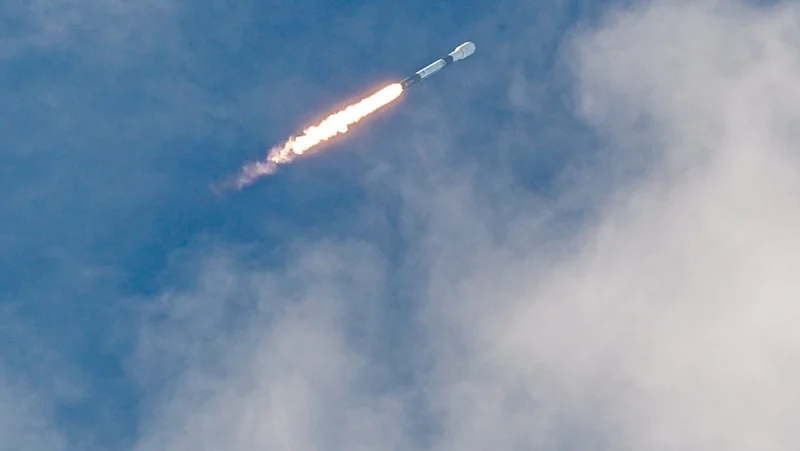
A SpaceX Falcon 9 upper stage is on course to slam into the Moon in the coming days, an end to a long, odd orbit that has kept the 45-foot second stage circling Earth since January 2025. Bill Gray, who tracks objects through his Project Pluto software, identified the rocket body as 2025-010D after analyzing ground observations from telescopes and surveys.
The object is moving at about 5,400 mph, which is more than seven times the speed of sound. That is fast enough to make the final approach to the Moon, but not fast enough to keep the stage from remaining in a highly elliptical orbit around Earth for months before this latest prediction put impact ahead. The collision is expected on the Moon's near side.
That is why the timing matters now. The upper stage was part of a January 2025 launch from the Kennedy Space Center in Florida that carried an uncrewed lunar lander, while the Blue Ghost lander reached the Moon's surface in March and operated for a complete lunar day of about 14 Earth days. The Falcon 9 stage never followed that path. Instead, it stayed aloft, taking 26 days to complete one trip around Earth and heading somewhere its designers never meant it to go.

The contrast is sharp. Most Falcon 9 upper stages eventually reenter Earth's atmosphere, but this one appears to have gotten stuck in orbital limbo and drifted toward the Moon instead. The first stage of the Falcon 9, with its nine Merlin-class engines, is built to return to Earth for controlled recovery. This 50,000-pound upper stage has no such ending, and the Moon has no atmosphere to burn it up before impact.
If the prediction holds, the crash should carve a fresh crater into the lunar surface. The bigger question is not whether the Moon will take the hit, but whether instruments on Earth can catch the dust and debris from more than a quarter-million miles away before the signal disappears. For now, Bill Gray has given the stage a destination, and the Moon is the one that has to absorb it.
