


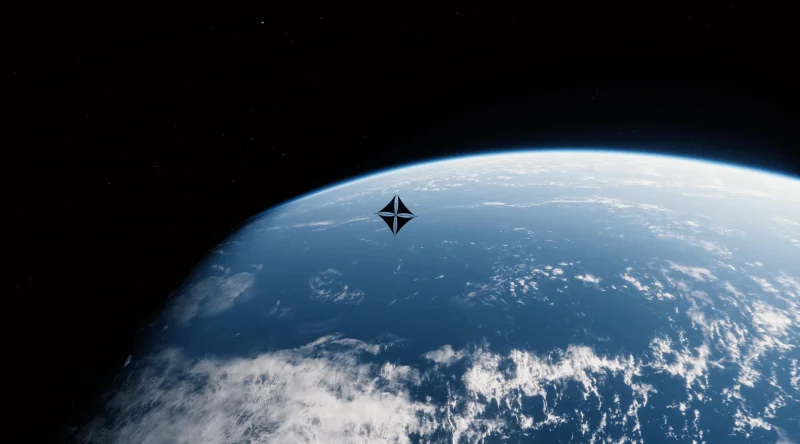
The Federal Communications Commission approved Reflect Orbital’s Eärendil-1 on July 9, clearing the company’s first satellite to test a space mirror that would send reflected sunlight to targeted areas on Earth for several minutes at a time. The 142-kilogram spacecraft is scheduled to launch later this year, carry an 18-meter reflector and operate in an orbit 600 to 650 kilometers above the planet.
The approval gives Reflect Orbital a formal green light for a highly unusual experiment: using sunlight gathered in low Earth orbit and aimed back at the ground when it is dark below. Ben Nowack said the license is the first step toward rigorously testing the company’s technology’s efficacy and the safeguards it has developed. The company says the concept could one day help construction sites, search-and-rescue efforts and even solar farms.
That is exactly why the project has drawn so much attention. Reflect Orbital’s application landed nearly a year ago and generated nearly 1,900 comments, mostly critical of the idea. Astronomers warned that spacecraft built around thin-film reflectors could interfere with observations and even pose risks to instruments and people looking through telescope lenses. Environmentalists warned that a constellation of such satellites could disrupt the diurnal cycles of plants and animals.

The criticism was not vague. Tony Tyson said on June 4 that the plans were even crazier than the broadband satellite constellations astronomers have worried about for years. He said the thin-film reflectors might not be able to direct sunlight precisely and could scatter it across a wider area. “Imagine the sky full of moons,” Tyson said. The European Southern Observatory went further, saying a full constellation of 50,000 satellites could raise background sky brightness at its facilities by a factor of three to four, limiting the ability of telescopes to detect faint objects.
Even so, the FCC said concerns about Eärendil-1’s impacts on astronomy or the environment were outside its jurisdiction. That narrow reading leaves the agency focused on the spacecraft itself, not on the wider consequences people fear from thousands of similar satellites. It also leaves the central technical question unanswered: whether a thin-film reflector 18 meters on a side can really steer sunlight to a specific patch of Earth without washing light over a much broader area.
For now, the approval is a milestone rather than a proof. Eärendil-1 is supposed to be the test that shows whether the idea works at all, and whether the safeguards now on paper can hold up in orbit. The next answer that matters is not in the license but in the launch later this year, when the company will find out whether its first space mirror can do more than promise daylight after dark.
