


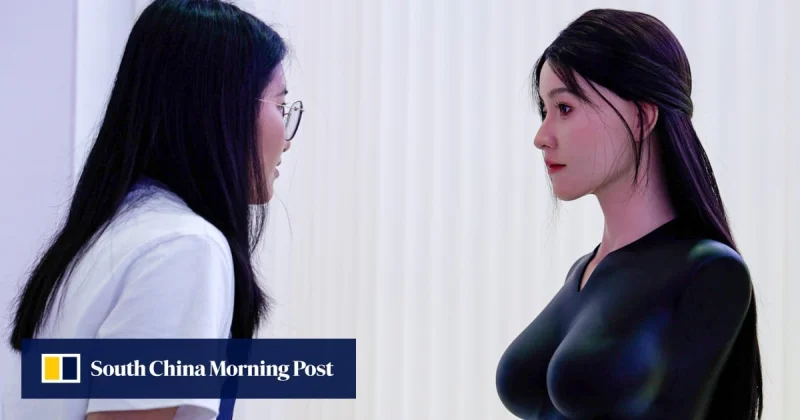
UBTech introduced the UWORLD U1 Series on June 30 in Shenzhen, pitching it as a full-size ultra-bionic humanoid robot platform built for mass production and companionship. The company described it as the first of its kind and tied the launch to a broader push for real-world deployment.
That is why the announcement matters now. The search term is not about a concept video or a lab prototype; it is about a product debut that tries to move humanoid robots closer to everyday use. UBTech says the platform combines biomimetic skin, embodied AI hardware, an OS, and emotion-driven LLMs, with 88 degrees of freedom and a dual-pivot biomimetic cervical spine that can reproduce up to 90 percent of fundamental human movements.
UBTech also said the robot can identify more than 20 fine-grained emotional states with over 90 percent accuracy. Its biomimetic fast-and-slow brain architecture is designed to deliver reactions in about 500 milliseconds, while the facial expression actuation system synchronizes speech and lip movements with less than 20 milliseconds of latency. Agent Memory OS is meant to sustain long-term interactions, and the proactive care engine allows wake-word-free communication and context-aware responses.
The company’s pitch is ambitious, but the path from launch event to daily use is still not spelled out. UBTech says the platform is designed for system-level manufacturing and long-term deployment, yet it has not explained how consumers or commercial users will actually buy it, when it will ship, or which applications will arrive first. The privacy architecture is framed as a selling point, with local-first processing, minimal cloud reliance and user-controlled hardware protections built in from the start.
UBTech also outlined a three-stage vision for human-robot collaboration: hazardous work and repetitive tasks first, then companionship and service in everyday life, and finally seamless interaction between people and intelligent robots. That roadmap gives the launch its logic, but it also leaves the key question open: whether the UWORLD U1 Series is already ready for the world outside the stage, or still waiting for the machinery of production to catch up with the promise.
