


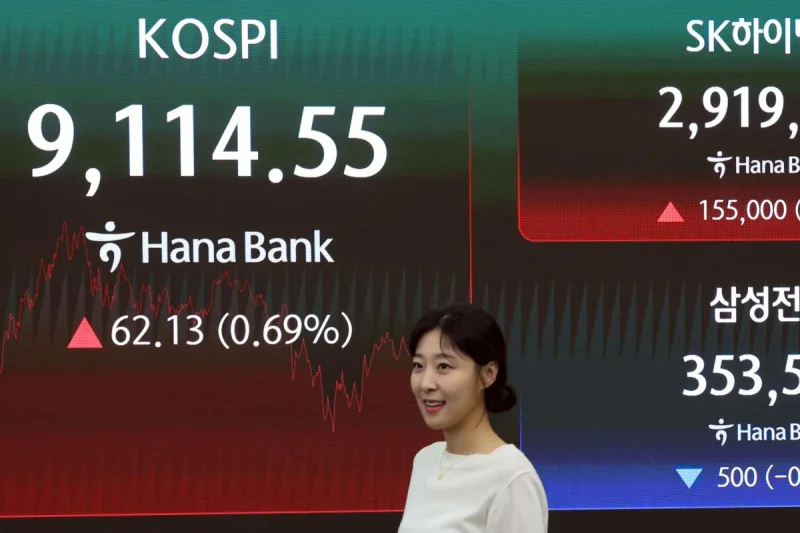
South Korean stocks ended at an all-time high on Monday, with the KOSPI climbing 62.13 points, or 0.69 percent, to 9,114.55 as semiconductor shares powered the market higher. The benchmark briefly touched 9,253.00 during the session before easing back, but the record close still held.
The move came as traders focused on signs of progress in U.S.-Iran talks after Washington and Tehran wrapped up their first round on Sunday and agreed on a road map toward a final deal within 60 days. Kang Jin-hyeok said negotiations went smoothly overall despite aggressive messages, which he described as short-lived noises, and that easing tone helped keep risk appetite firm on a day when the market was already leaning on chips.
That support was strong enough to push the index higher even as foreign investors sold a net 2.55 trillion won and losers outnumbered winners 739 to 148. Retail investors bought a net 2.15 trillion won and institutions added 308.4 billion won, giving the session a split character: broad selling underneath, but a heavy bid for the names that mattered most to the index.

SK hynix jumped 5.61 percent to 2.92 million won and, for the first time, overtook Samsung Electronics in market capitalization. SK Square surged 10.67 percent to 1.97 million won, while Hanmi Semiconductor rose 2.2 percent to 301,500 won, showing how far the chip trade spread beyond one stock. That strength was enough to offset weakness in several large names, including Samsung Electronics, which fell 0.14 percent to 353,500 won, Hyundai Motor, which dropped 5.22 percent to 581,000 won, and LG Energy Solution, which dipped 4.7 percent to 385,500 won.
Samsung Electro-Mechanics lost 1.85 percent to 2.23 million won, Samsung Life Insurance slid 9.36 percent to 450,500 won and Samsung Biologics retreated 5.75 percent to 1.3 million won, yet the KOSPI still finished at a record because the heaviest buying concentrated in the semiconductor corner of the market. Trade volume reached 377.2 million shares worth 41.4 trillion won, a sign that the rally had real weight behind it even as the board was red overall.
The broader backdrop was also uneasy. The talks had been at risk of breakdown after Tehran said it had closed the Strait of Hormuz, while President Donald Trump repeated threats to resume attacks on Iran. Yet the market chose to trade the road map, not the threat, and the result was a clean record close. The question now is whether that chip-led advance can keep carrying the KOSPI if foreign investors stay on the sell side and the gains remain concentrated in a handful of names.
