


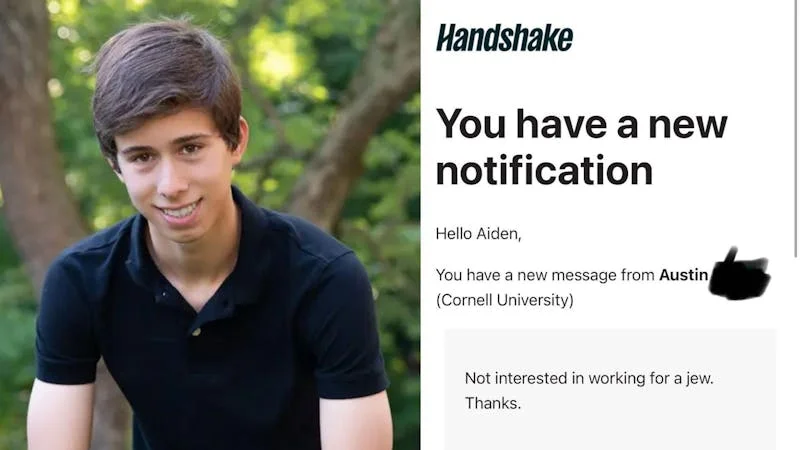
Cornell reported Austin Franco ’28 to the Office of Civil Rights after a Handshake exchange in which he allegedly wrote, “Not interested in working for a jew. Thanks.” The report followed a job-related message that moved from a private hiring thread into a public bias case.
The response spread quickly once Gabe Einhorn posted the screenshot on X on June 8, and it drew more than two million views in less than a week. Einhorn said he crossed out Franco’s last name before posting, but comments on the thread still exposed who the student was, turning what began as a hiring exchange into a wider online confrontation.
Franco had applied on May 26 for a growth and sales role at VrfyID through Handshake, and he was accepted in the first round. Aiden then asked him to set up a meeting on May 29, Franco replied that same day with times he was available, and Einhorn said he and Aiden offered two dates for students to attend. Franco did not go to either one, and Aiden followed up on June 8 to ask about his attendance before the message that triggered Cornell’s report.
That timeline matters because it is the specific process at issue: an application, an acceptance, a scheduling exchange, a missed meeting, then a reply that Cornell treated as a bias incident and sent to the Office of Civil Rights. What is not clear is what Cornell or the Office of Civil Rights will do next, beyond the report itself.
Einhorn said he is a “proud Jew” who always wears a kippah, and he said he wanted to “prove a point to people that antisemitism exists.” He also described the post as a way to show what happened, not to cause lasting damage to the student. But the result did not stay contained. Franco said he learned about the X post on Monday morning and began facing doxxing and intimidation after it was shared.
Franco said the harassment included “digging up personal information, harassing via email and phone employers, and receiving threats.” On June 9, he wrote on X that his experiences with Jews had not been pleasant, while also saying that had not been true in every case. He also said he had been doxed and intimidated by Einhorn’s community and that his personal life had been investigated for no other reason than a sin.
The gap between intent and impact now sits at the center of the case. Einhorn said he blurred Franco’s name to avoid personal damage, yet the comments did what the screenshot alone did not. Cornell has already labeled the exchange a bias incident and sent it to the Office of Civil Rights. The next question is whether that referral becomes discipline, or whether the university leaves the public fallout to stand on its own.
