


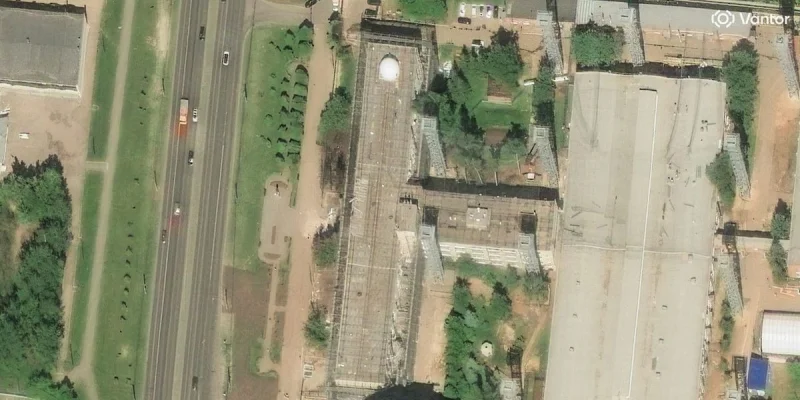
Ukraine said on Wednesday that long-range attacks hit a military factory in Cheboksary and a refinery in Russia’s Samara region, widening a campaign that has pushed strikes far beyond the frontline. Volodymyr Zelenskyy said the Cheboksary target was hit by Ukrainian FP-5 Flamingo long-range missiles and that the refinery strike was part of the same wave of deep attacks.
The Cheboksary plant sits in Chuvashiya, more than 900km from the frontline, and supplies components for Russian drones and missiles. The distance matters because it shows how far Ukraine’s long-range weapons can reach at a time when both sides are trying to shape the war behind the front lines as much as on them.
Ukraine’s president said the force behind the Cheboksary strike was the FP-5 Flamingo missile, one of the systems Kyiv has been promoting as part of its expanding long-range arsenal. The Astra online news outlet said the target was the VNIIR-Progress plant, which produces antennas for drones, and Oleg Nikolayev said the attack on the Cheboksary plant was confirmed in Chuvashiya.

In Samara, Zelenskyy said Ukrainian forces also struck a refinery. Vyacheslav Fedorishchev said industrial plants were damaged by drone strikes in the region and three people were injured. Astra published images of a large fire at the refinery, while cited industry sources saying Rosneft’s Kuibyshev refinery in Samara halted oil processing on 10 June after a drone attack.
The Samara refining hub has already taken repeated hits. It includes the Kuibyshev, Novokuibyshevsk and Syzran plants, with Syzran offline since 21 May after a drone attack and Novokuibyshevsk shut down on 18 April and later running at reduced throughput. That makes the latest strike part of a pattern that has repeatedly disrupted one of Russia’s key oil-processing clusters.
There is still a gap between the claims and the damage that can be independently measured. Russian authorities described fires and industrial damage, while Zelenskyy framed the same campaign as successful deep strikes by Ukraine’s long-range weapons, and neither side has fully answered how badly the Cheboksary plant or the Samara refinery were hit, or whether either facility is still operating normally. What is clear is that the war’s reach is no longer measured only in trench lines and shell craters; it is being measured in smokestacks, fuel output and plants that sit hundreds of miles from the front.
