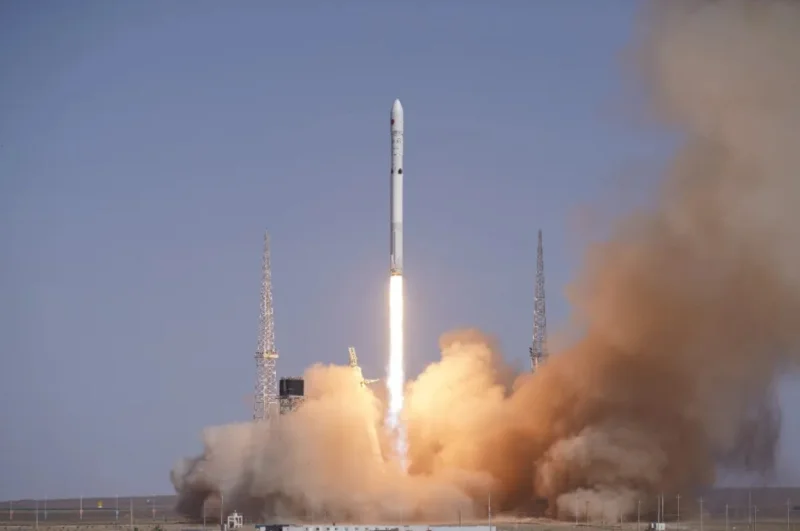
China launched the first Long March 12B on June 1 and put Qianfan satellites into orbit, giving the country’s new reusable rocket its debut mission and adding another piece to a fast-growing broadband constellation. The liftoff came at 4:40 a.m. Eastern, or 0840 UTC, from the Dongfeng Commercial Aerospace Innovation Test Zone at Jiuquan Satellite Launch Center in the Gobi Desert.
The launch matters now because it landed without warning. There were no apparent airspace notices issued ahead of time, and the first signs that something had happened surfaced on Chinese social media before the state aerospace contractor announced success within an hour. For a maiden flight carrying operational payloads, that made the launch stand out even before the orbit details emerged.

The payloads were tied to Shanghai-led Qianfan broadband megaconstellation, a project that is building out coverage with repeated batches of satellites. CASC did not immediately confirm how many spacecraft were aboard, but if the mission matched the usual batch size of 18, it would bring the constellation to 180 satellites in orbit. Orbital tracking data later showed that the launch inserted two Qianfan satellites into polar orbits between 1,020 and 1,048 kilometers altitude, while the upper stage ended up in a 737 by 1,022 kilometer orbit.
The rocket itself was built for more than one trip. The Long March 12B is a two-stage vehicle with a 4.37-meter-diameter core and an overall length of about 72 meters, powered by nine YF-102R engines on the first stage and a single YF-102RV vacuum engine on the second. CASC says it can lift about 20,000 kilograms to low Earth orbit, was designed to cut launch costs, and can be adapted for multiple orbit profiles.
That design goal was still only partly on display. The maiden mission did not include a first stage recovery attempt, even though the rocket is meant to be reusable. CASC said a recovery test will come later, which leaves the next launch-related milestone not in the ascent itself but in whether the booster can be brought back the way the program intends.