


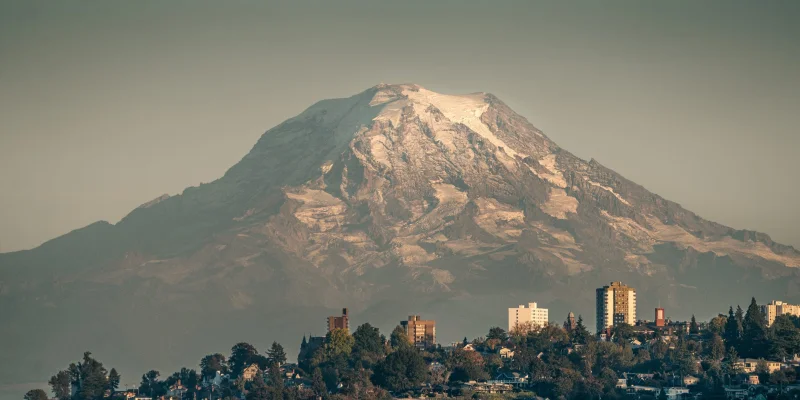
Scientists say the most dangerous thing at Mount Rainier may not be an eruption at all. A lahar — a fast-moving volcanic mudflow — could race down the mountain and destroy communities in Washington’s path in as little as half an hour, with some places facing even less time to react.
That urgency is why the volcano is drawing fresh attention now. Mount Rainier sits about 60 miles from Seattle, and roughly 150,000 people live in Pierce County in the middle of its projected lahar path. In a worst-case scenario, a landslide starting on the western side of the mountain could demolish Orting, Puyallup and Sumner in just half an hour, threatening more than 60,000 residents.
Andy Lockhart, a scientist who has spent years thinking about these hazards, called no-notice lahars “the thing that goes bump in the night.” He added, “It creeps me out.” That unease comes from how quickly the danger can unfold. A lahar can flow down a volcano in mere minutes and level nearly everything in its way, which is why U.S. Geological Survey researchers have described lahars as the most threatening hazard in the Cascades.
The scale of the warning is easier to understand in the shadow of Mount St. Helens. In 1980, the volcano erupted after a 5.1-magnitude earthquake triggered the disaster, killing 57 people and causing $860 million in damage. Scientists say the ruin from that event had less to do with the eruption itself than with the huge lahar it generated, a reminder that the deadliest part of a volcanic disaster can be the mud and debris racing downhill, not the blast people imagine first.
That is also what makes Rainier so hard to plan for. A lahar can begin without an eruption or any other seismic event, and around the world they have been triggered by dam failures and heavy thunderstorms. Lizeth Caballero García said they are “complex phenomena” that change a lot during transport, adding that “they can grow, they can dilute.”
The contradiction is stark: residents are trained to think of volcanic danger as something that starts with an explosion, yet the most dangerous flow can arrive on its own. The Cascades Volcano Observatory has built an extensive network of monitors across the range to detect lahars and volcanic activity, but the open question is whether those systems can ever give people in towns like Orting enough time to get out before the ground starts moving under them.
Scientists will keep studying the hazard with monitors and experimental flumes, but the warning from Rainier is already clear. For the people in its path, the question is not whether the mountain can change a life in a matter of minutes. It is whether they will hear it coming.
