


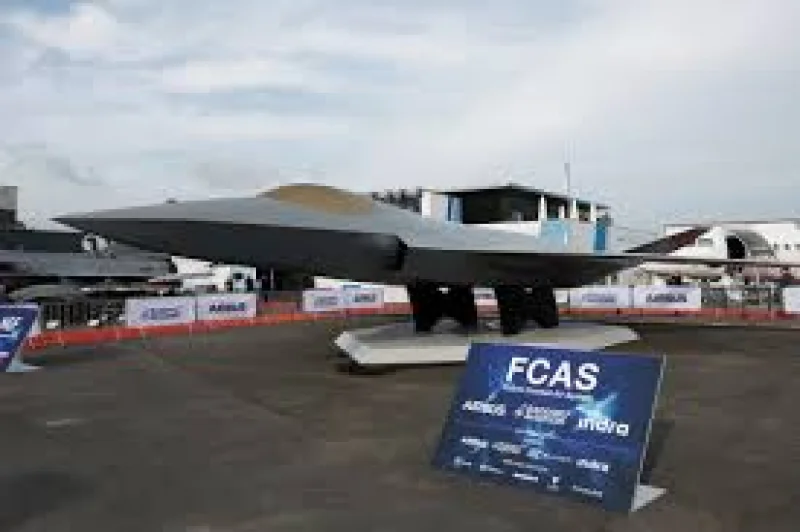
France and Germany have abandoned their joint Future Combat Air System fighter jet project after officials in Berlin said the companies involved could not agree on a way forward. The decision ends, for now, a flagship effort meant to give Europe a next-generation combat aircraft and deepens the split between the two industrial camps behind it.
The move matters today because it lands as a major shift in one of Europe’s biggest defence projects, a programme launched in 2017 by Emmanuel Macron and Angela Merkel and estimated at €100bn. It was meant to replace France’s Rafale jets and the Eurofighter used by Germany and Spain by about 2040, and its collapse as a joint fighter project raises fresh doubts about how Europe builds military power together.
An unnamed official said Macron and Friedrich Merz had reached a shared assessment that the companies would not be able to come together, adding that they acknowledged that reality. The project had been dragged into months of friction between Dassault Aviation, which represents French interests, and Airbus, which speaks for German and Spanish interests, over who would lead the work and how much technology would be shared.
Dassault wanted to be the lead partner to protect its intellectual property, while Airbus pushed for a more equal partnership with significant technology transfers. France wanted a single European model for the jet, but Germany argued its needs were not the same, pointing out that French aircraft must be able to carry nuclear weapons and land on aircraft carriers. Merz has also previously questioned whether developing a crewed sixth-generation fighter jet still makes sense for Germany’s air force.
There is still a narrower path for parts of the programme. A German government source said the actual core of FCAS is to be continued as a European system, describing it as a nervous system that networks aircraft, drones and other components into an integrated whole. That leaves open whether the drones and the high-security combat data cloud can move ahead separately, even though the joint fighter jet project itself has now been abandoned.
Two mediators, one from each country, were sent in March to rescue the initiative, but they failed to produce a workable proposal. Leaders discussed ending the troubled project on the sidelines of a summit in Montenegro on Friday, and the confirmation on Monday made clear that the political will to save the partnership had run out before the industrial dispute was resolved. European efforts to cooperate more closely on defence, sharpened by years of underinvestment and concerns about Russia and the United States, now face another hard test.
