


Netflix’s three-episode docuseries on Michael Jackson opens where the case turned public: with law enforcement serving a search warrant on his 2,700-acre Neverland ranch near Santa Barbara, California. The footage shows officers moving through bedrooms, hidden stairwells and rooms filled with dolls, videotapes and figurines, setting the scene for a case that would follow Jackson into court.
The series is titled Michael Jackson: The Verdict, and it arrives now because the Neverland ranch search still carries the weight of everything that came after it. Jackson had already faced child molestation accusations in 1993, when he settled with 12-year-old Jordy Chandler and his family for $23 million, and he was accused again in 2003 of multiple counts of child molestation.
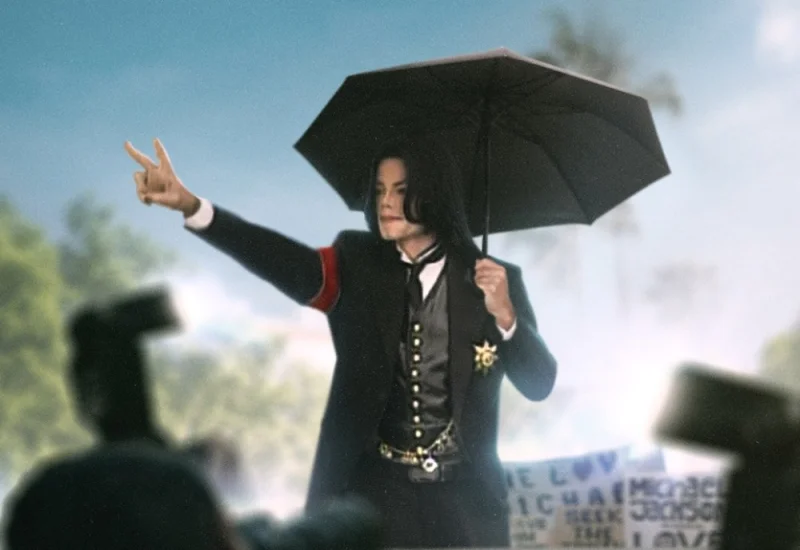
From there, the documentary moves through the indictment, trial and verdict with archival footage, trial notes, clips and interviews from people close to the case. It also returns to the media frenzy around Jackson, whose eccentricities and legal battles became inseparable from his public image. The focus is not only on what happened in court, but on how the case was watched, packaged and argued in public before the jury ever reached a decision.

Former journalist Martin Bashir is part of that history through Living With Michael Jackson, the documentary he made after Jackson invited him to Neverland. In that film, Jackson is seen clutching Gavin Arvizo’s hand and speaking about sharing a bed with the boy on multiple occasions, material that became central to the scrutiny surrounding him. The new series uses that record to revisit how close the story had already moved from private invitation to public prosecution.
The sharpest part of the series is its suggestion that the trial was not going to feel fair on either side. It offers the details that led to Jackson’s acquittal after the 2005 trial, but it also points to a process shaped by celebrity, outrage and a courtroom atmosphere that could never fully escape the outside spectacle. That leaves the most important question hanging not over guilt or innocence, but over how much of the verdict was formed by evidence and how much by the machinery around it.
What the documentary makes clear is that Neverland was never just a home. It became the place where the case was searched, argued and remembered, and the search footage now gives the story a fresh opening without changing its oldest uncertainty: how a trial so public could ever have felt private enough to be judged cleanly.
