


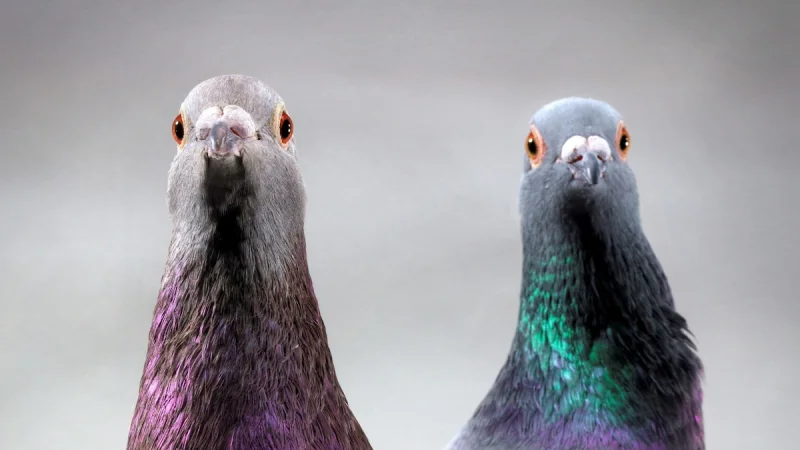
Scientists in Germany say they have found where homing pigeons keep an internal compass that has puzzled biology for generations: in immune cells tucked inside the birds’ livers. The new study in Science suggests the magnetic sensor is not in the eyes, beak or ears, but in iron-laden macrophages nestled against nerve fibers.
The finding matters now because it points to a physical location for a sense that researchers had hunted for more than a decade in this project and that zoologists have suspected since at least the 19th century. In the 1960s, captive robins were shown to change their movements when exposed to artificial magnetic fields, and since then scientists have argued over whether birds read Earth’s field with compounds in their eyes, particles in their beaks or fluid in their inner ears.
Martin Wikelski began chasing the question more than a decade ago after a chance meeting with Christian Kurts at a conference coffee break. Kurts recalled the moment as an eureka moment and suggested a simple next step: maybe test whether these cells are involved. Wikelski said the mystery had lasted for a century and that nobody had been able to solve where it sits or how it works. “Now, we think we have found, really, a workable solution,” he said.
To reach that conclusion, the team screened the eyes, beak, brain, spleen and liver of pigeons and then ran a series of experiments on 34 birds trained to fly a 12-mile route through the German countryside. The researchers reported large concentrations of iron-laden macrophages in the liver tissue, with the cells positioned right beside nerve fibers. That arrangement is why the team thinks the organ may house the birds’ magnetic sense rather than merely filtering blood and storing nutrients.
Even so, the mechanism is not settled. Clivia Lisowski said the layout makes it very likely that the nerve cells and macrophages are communicating, but the study does not yet explain how that signal is turned into navigation. Earth’s magnetic field passes through an animal’s body, so the remaining question is not whether pigeons can be exposed to it, but how those liver cells convert it into a usable compass. The discovery gives scientists a new place to look, and a new test to fail or confirm.
That is the real shift here: after decades of theories about eyes, beaks and inner ears, the search has moved to the liver, where the next experiments will have to show whether the immune cells are the sensor itself or part of a larger circuit still out of view.
