


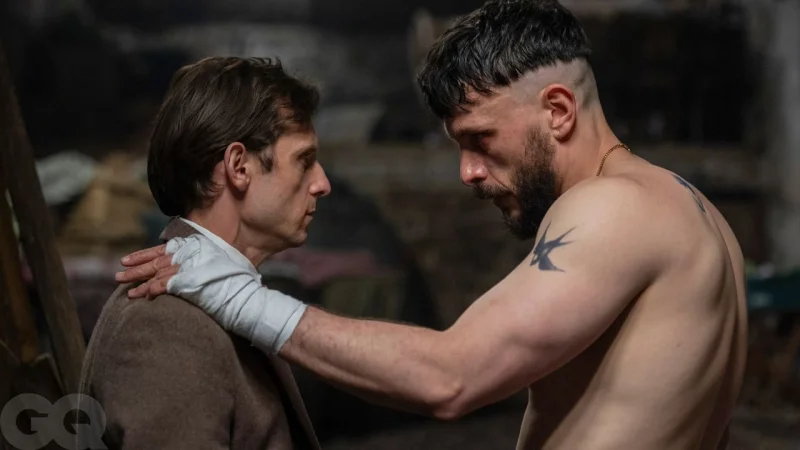
Richard Gadd’s Half Man ends by cracking open the rules it spent most of the series pretending to follow. In the finale’s penultimate prison scene, Ruben tells Niall that his father sexually abused him, and the confession lands with the blunt force of a verdict: “It fucks you up man,” he says, before adding, “it makes you a fucking half-man.”
That ending is being picked over now because Half Man has been sold, and largely understood, as a work that opens each episode with wedding reception scenes so difficult to place in time that they feel like fragments of memory. The final stretch forces the audience to read those fragments differently, not as clutter but as a map of damage. For viewers searching Half Man episodes after the finale, the question is not just what happened in the prison, but what the show has been doing all along.
The comparison at the heart of the piece is also the show’s most unsettling idea. Ruben and Niall are treated as two unbalanced aspects of a single self, locked into a relationship that is part confrontation and part confession. Ruben’s admission to Niall makes that reading hard to escape. It is not simply a disclosure of abuse; it is the moment the series turns its private pain into the logic of its structure.

That is why episode four matters so much. Up to that point, Half Man has the feel of uncompromising realism, but episode four breaks the spell completely, plunging into a slow-motion world suffused with ethereal music. Three men storm a barn door, wedding guests gaze calmly from a distance, and then police cars and officers arrive with battering rams. The sequence is not just odd. It is a deliberate refusal of the show’s own supposed rules, and it makes the finale’s prison scene feel less like a sudden twist than the destination of a series that has been bending reality from inside.
The article’s reading also puts Half Man in sharper contrast with Baby Reindeer, Gadd’s first series, which drew raw emotional drama directly from his own life. Here, the fiction gives him more room. It can reach personal and social wounds without claiming the authority of autobiography, and that freedom is what makes the finale more disturbing, not less. Ruben can say that abuse “fucks you up” and “makes you a fucking half-man,” and the line resonates because the show has already trained viewers to hear a split self inside it.
There is still one unresolved edge to the ending: the finale does not tidy that split away. It leaves Ruben’s confession hanging over the series, with the prison scene doing more to expose than to heal. That is the point. Half Man does not close by answering what the fracture means. It closes by showing how long it has been there.
