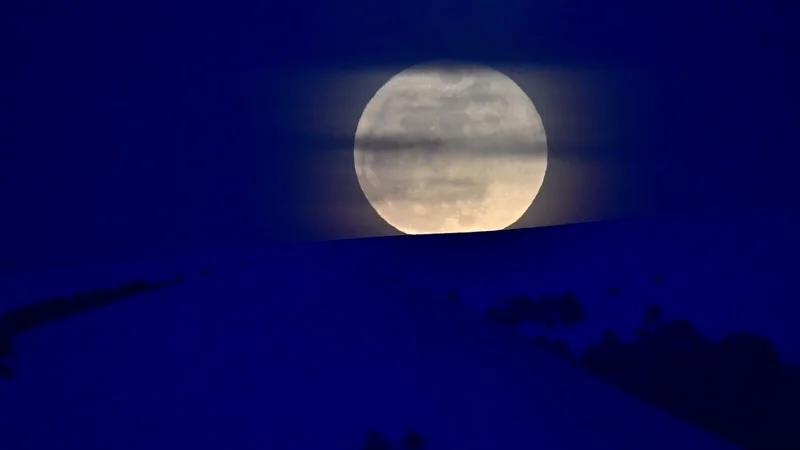
The second full moon of May will rise on May 31 and, for some stargazers in the Southern Hemisphere, it will do something even rarer: slip in front of the red star Antares and briefly hide its light. Astronomers call that an occultation, and this one lands on a Blue Moon, the name given to the second full moon in a calendar month.
That is why searches for what is a blue moon are spiking now. The event happens only roughly once every 2.5 years, and this one has a clear viewing path: stargazers in southwestern Australia, New Zealand, Fiji, Argentina, Chile and other southern hemisphere nations will see the Blue Moon rise at sunset on May 31.
For observers in North America, the timing is different. On the evening of May 30, the Blue Moon rises in the east as the sun sets, with Antares about 3 degrees to the lower left of the Moon. By sunrise on May 31, the Moon has set and Antares has moved to the top of it, a quiet reminder that the sky is in motion even when the scene looks still.
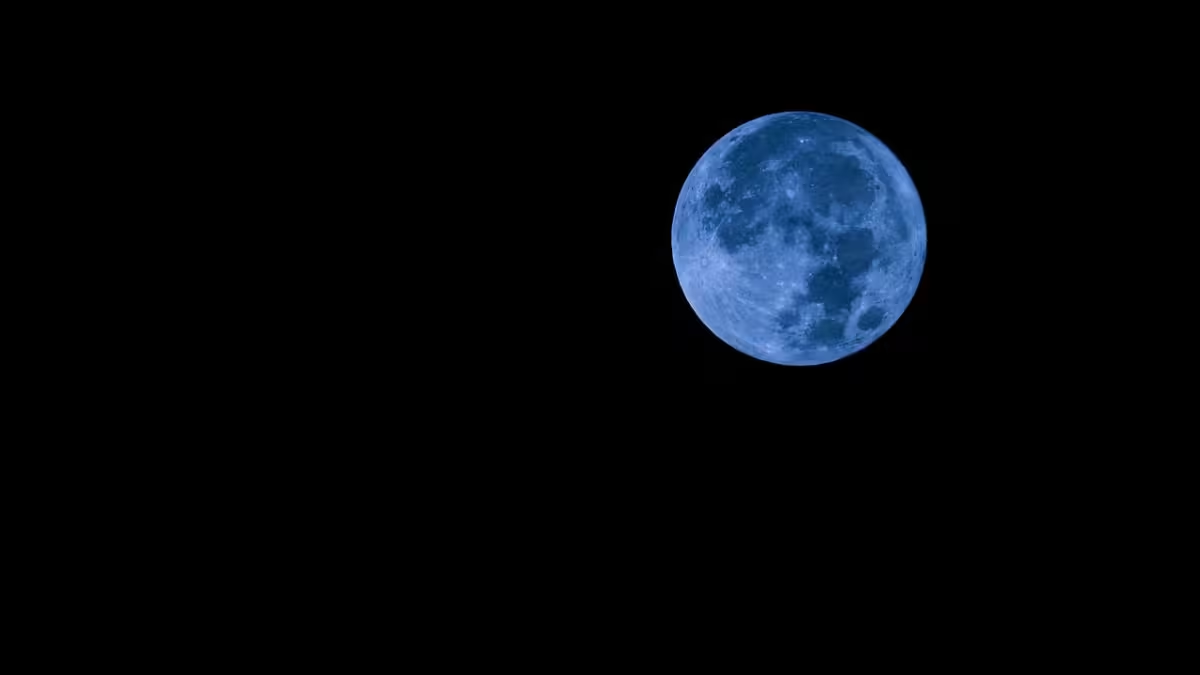
The name can be misleading. Blue Moon does not mean the Moon suddenly changes color, and it is not a dramatic shift in the sky’s appearance. The term also has a second meaning: it can describe the third full moon in a season that has four full moons, a quirk tied to the Gregorian calendar and the Moon’s orbit.
That calendar logic is what gives the event its odd mix of ordinary and rare. A full moon arrives every month, but the second one in the same calendar month only comes around roughly once every 2.5 years. When that timing lines up with Antares, the result is a short-lived alignment visible from a narrow stretch of the globe. The next Blue Moon comes in 2026, but the exact date is not yet part of the picture here.
For anyone watching on May 31, the Blue Moon will not just be another full moon on the calendar. It will be the month’s second, a passing event with a named star tucked into the frame, and for some southern hemisphere viewers, a brief disappearance that makes the definition of Blue Moon easier to remember than the name itself.