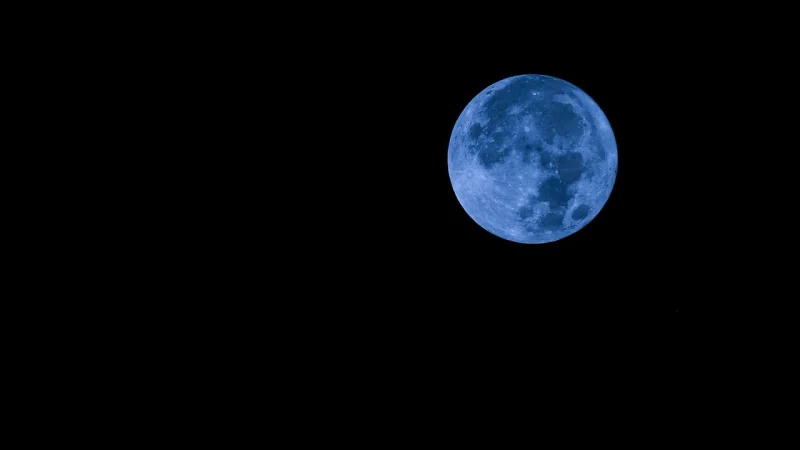
The first calendar Blue Moon since Aug. 30, 2023 rises on May 31 at 4:45 a.m. Eastern Time, closing out a rare stretch in the lunar calendar with a second Full Moon in May.
That makes this full moon the Blue Moon, following the first Full Moon of the month on May 1. It is also a micromoon, appearing smaller because the Moon is at apogee, farthest from Earth in its elliptical orbit, and that distance makes the lunar disk look reduced in the sky.
The timing gives the night a particular weight. Sarah Potter said a Blue Moon “symbolizes a highly charged time for completion, letting go of what no longer serves us, and embracing novel opportunities.” She also said that because it is the second Full Moon in May, “it provides a window for manifestation,” and called it “a lovely moment to set long-term goals or to let go of something that needs a major boost to release and grieve to move forward into the next phase of your life.”
Potter added that, paired with Sagittarius energy, the moon encourages “a leap of faith toward the life we truly want,” with growth possible once people stop shrinking themselves to fit old fears, old identities or outdated limitations. The rare lunation does not come around often; after this one, the next is set for Dec. 31, 2028.
The contrast is part of what makes Friday’s sky event stand out. The Blue Moon marks the culmination of the current lunar cycle, yet the same orbit that makes it rare also leaves it looking smaller than usual. The Moon’s path is not a perfect circle, and this one arrives at the farthest point of the year, a reminder that the most notable lunar moments are not always the biggest ones.
For skywatchers, the significance is simple: this is the last chance in years to catch a calendar Blue Moon, and it arrives before dawn on May 31. For anyone drawn to the symbolic side of the moment, the message from Potter is just as direct: finish what is ready to end, choose what comes next, and do not wait for another rare moon to begin.