


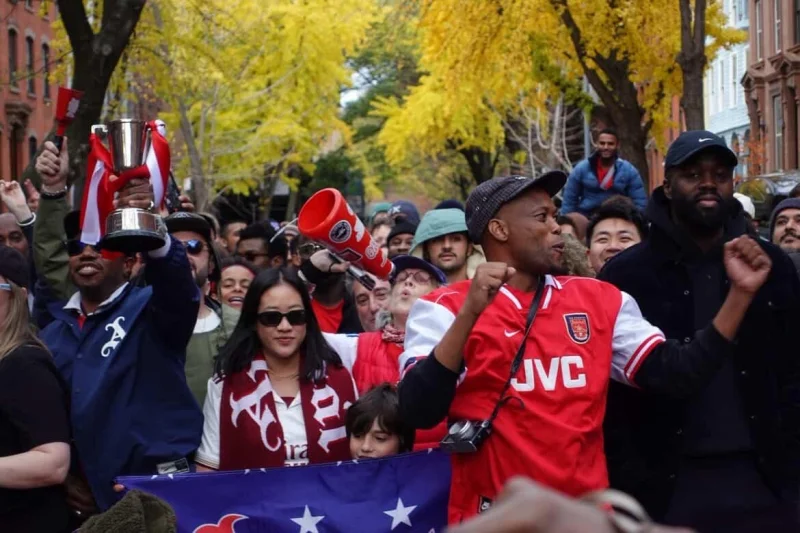
When Arsenal won the Premier League title last week for the first time in 22 years, the reaction across Africa was immediate and loud enough to spill into streets, highways and city squares. Now the same fan culture is waiting for tonight’s Champions League final against PSG, with more than 150 million people expected to watch and Arsenal supporters across the continent bracing for a celebration that could dwarf last week’s scenes.
In Kenya, the title win turned into something close to a public holiday. Tens of thousands of people, and possibly as many as a million, poured into roads and open spaces after the final whistle, climbing lamp-posts, waving flags, singing club songs and bringing traffic to a halt. One supporter in Kenya called it a victory that had overcome “the hatred of the entire world,” a line that captured how deeply this club has lodged itself in daily life far beyond North London.
The scale of the response is not a new accident. In Nairobi, Addis Ababa, Kampala, Lagos and Zamfara state, fans claimed the title as if it were their own, and in Kenya some even made a celebratory pilgrimage to the grave of Raila Odinga after the win. In Ethiopia, Addis Ababa became a city of car parades and chanting crowds. In Uganda, thousands gathered in Nsambya in Kampala for an all-night concert called “vimbisa Arsenal” after watching on giant screens, while one fan livestreamed the event for supporters who could not get there.
That intensity grew out of two decades of access and identity. Premier League broadcasting spread across Africa in the 1990s, and in 2000 the South African satellite network DStv acquired the rights and began showing live matches across sub-Saharan Africa through SuperSport. Arsenal benefited more than most. Arsène Wenger joined from the Japanese league in 1996, and by the time he left in 2018 the club had become a symbol of African football’s rise in the Premier League and of London’s African diaspora.
That is also the friction inside Arsenal’s rise: African and African-descended players helped make English clubs must-see television, but this new football public did not fully find a symbolic home until Wenger’s Arsenal. Manchester United, Liverpool and Chelsea had already built followings after the Premier League launched in 1992, yet Arsenal’s blend of style, access and success gave millions of African fans a club that felt like theirs. If Arsenal beat PSG later today, the celebrations are likely to reach from viewing centres to highways all over again, and perhaps farther.
