


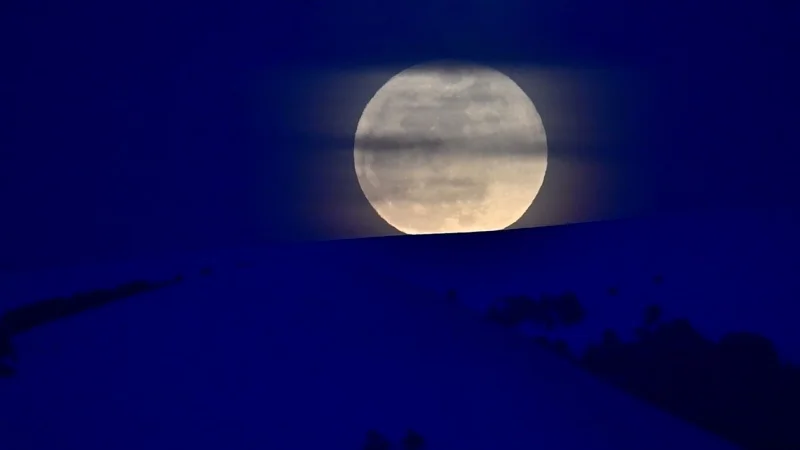
A blue micromoon is due on 31 May, with the full moon exact at 9.45am BST. For people in the UK, the timing means the moon will have already set before the precise moment arrives, even though it will still look full the night before and the night after.
That is why search interest is spiking around Moon Tonight: the event is rare, the name sounds dramatic, and the details are tightly pinned to this weekend. The same full moon will occur at 4.45am Eastern Time in the US and 6.45pm AEST in Australia, giving observers in different regions a chance to catch the same lunar phase at different local times.
Dr Greg Brown said the moon will be “indistinguishable from being full the entirety of the night beforehand and basically the night after as well.” In practice, that means the sky will not offer a sharply different view just because the clock has passed the exact moment of fullness. The moon’s appearance will be close enough to full for casual viewers across that stretch, even if astronomers mark the precise time at 9.45am BST.
A blue moon can mean a second full moon in a single calendar month, while a seasonal blue moon is the third full moon in an astronomical season that has four full moons. This one also qualifies as a micromoon, which happens when a full moon occurs near its furthest point from Earth. That sounds unusual, but a micromoon is only about 6% smaller than a typical full moon and about 14% smaller than a supermoon.
Brown described the different lunar labels in plain terms. A monthly blue moon is “the one that’s better known” and “the simplest,” he said, while a micromoon is the opposite of the more familiar supermoon: “If a full moon happens to occur close to its closest point, then we call that a supermoon,” and “if it’s close to its furthest point, then we call that a micromoon.” Blue micromoons occur about once every couple of decades, which is why this one stands out even though the moon will not look dramatically different to most people.
The sky may also be less generous to viewers in the north than the name suggests. In the northern hemisphere, the moon will be relatively low in the sky throughout the night, while in the southern hemisphere it will sit very high. That positioning can matter more to the naked eye than the label attached to the phase.
There is one more reason to keep expectations grounded: a blue moon is not necessarily blue in color. The phrase refers to timing, not tint, unless dust from major forest fires or volcanic eruptions scatters light in the atmosphere and gives the moon a blue appearance for a separate reason. The moon’s orbit around Earth is elliptical, so its distance changes, which is why a micromoon and a supermoon are both real but modest-looking shifts.
For the UK, the next one using the same definition appears to be in 2066. Some parts of the world, including the US, will get the next blue micromoon in 2053. Until then, this weekend offers the nearest thing to a celestial marker that matters more for the calendar than for the eye: a full moon that arrives exact in the morning, after most British viewers have already seen it looking full enough the night before.
