


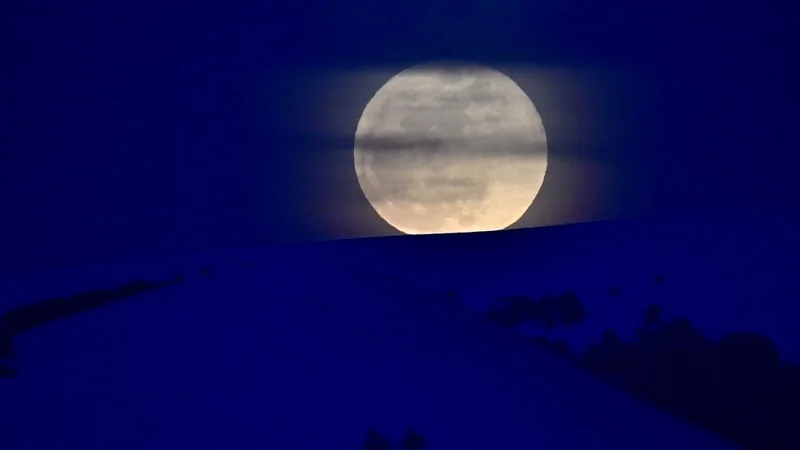
A rare blue micromoon will arrive on 31 May, with the full moon peaking at 9.45am BST and giving skywatchers a double rarity to look for this weekend. Dr Greg Brown said the next one in the UK appears to be in 2066, which helps explain why this moon is drawing attention now.
People are searching for it because the timing changes the way the event is classified depending on where they are. In the US, the full moon falls at 4.45am Eastern Time, while in Australia it is 6.45pm AEST, and different time zones and the international date line can mean one place counts a blue moon while another does not.
There is more than one definition of a blue moon, but the one most people use is the monthly version: a second full moon in one calendar month. Brown said that is the simplest and best known form, and it is the one that makes the rare blue micromoon possible when it lands alongside a micromoon, which happens when a full moon is near the moon’s farthest point from Earth.
The moon’s orbit is elliptical, so its apparent size changes, but the difference is subtle. A micromoon is about 6% smaller than a typical full moon and 14% smaller than a supermoon, which is why this week’s event will not look dramatically different to the naked eye. A blue moon also does not necessarily look blue; the name refers to timing, not colour, unless dust in the atmosphere gives the moon an actual bluish tinge during events such as major fires or volcanic eruptions.
Brown said the moon will be indistinguishable from being full the whole of the night beforehand and basically the night after as well, which means observers in the UK should still have a good chance of seeing it on Saturday or Sunday night if the sky cooperates. In the northern hemisphere, it will sit relatively low in the sky through the night, while in the southern hemisphere it will be very high.
That is the real story of this moon: rare on the calendar, modest in the sky, and easy to miss unless you know when to look. The next UK blue micromoon appears to be in 2066 using the same definition, though some parts of the world, including the US, may see one in 2053.
