


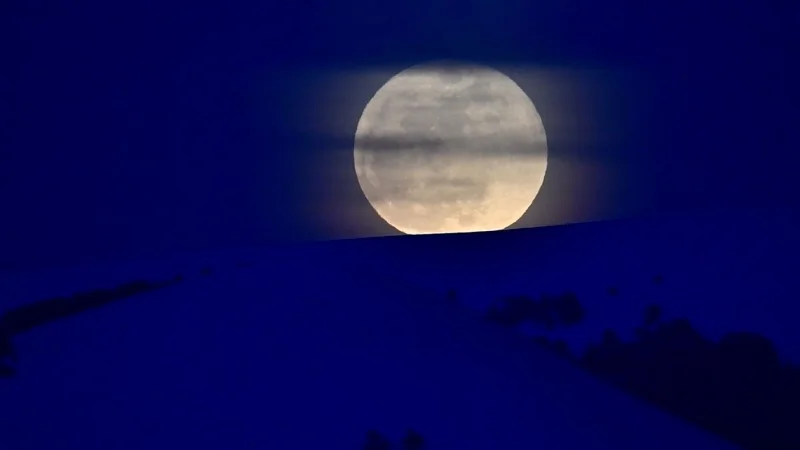
The full moon on 31 May will peak at 9.45am BST, making this weekend’s sky watch a rare blue micromoon rather than the sort of lunar event people can catch at a single glance in the UK. Dr Greg Brown said the moon will be long gone below the horizon by the time it reaches full phase in Britain.
That timing is why people are searching for May 2026 Blue Moon Times now: the exact moment lands in the morning, but Brown said the moon will look full on the night before and basically the night after as well. For viewers in the US, the full moon comes at 4.45am Eastern Time, while in Australia it is 6.45pm AEST, so the same event arrives at very different hours around the world.
A blue moon is the second full moon in one calendar month, or, in another usage, the third full moon in an astronomical season that has four full moons instead of three. A micromoon is the opposite of a supermoon in scale rather than name: it happens when the full moon is near the moon’s furthest point from Earth, and it appears about 14% smaller than a supermoon and about 6% smaller than an ordinary full moon. Put those together and you get a blue micromoon, a combination that turns up only about once every couple of decades.
Brown said the best chance to see it in the UK is to go out on Saturday or Sunday night, when the moon will be indistinguishable from full throughout the night beforehand and basically the night after as well. In the northern hemisphere it will sit relatively low in the sky, while in the southern hemisphere it will be very high. That means the event is real, rare and worth looking for, but not because it will change color.
The name can be misleading. A blue moon is not actually blue, unless dust in the atmosphere from major forest fires or volcanic eruptions creates a scattering effect that gives the moon a bluish tinge. This one is called a blue micromoon for the way the lunar cycle and the moon’s distance line up, not for what the eye will see.
For skywatchers in the UK, the next blue micromoon of this type does not appear to come until 2066. Some parts of the world, including the US, will get one in 2053, which is the sharper reminder here: this is the kind of lunar event people may hear about for years before they get another local chance to see it. Brown’s advice is simple enough, and it fits the moment. Go out this weekend, not at 9.45am, but Saturday or Sunday night, when the moon still looks full and the rare timing is easiest to appreciate.
