


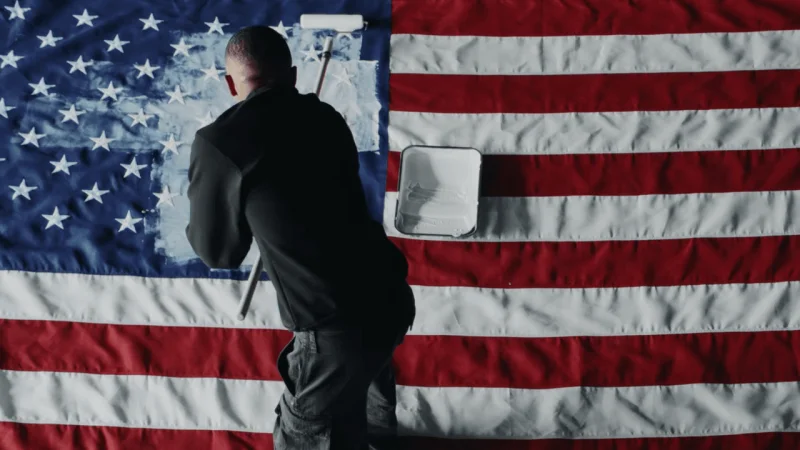
Vince Staples has released the music video for “White Flag,” a grim new visual that places an American flag under the shadow of the Ku Klux Klan before the rapper tears it down, paints it white and opens fire on it with an assault rifle. The 32-year-old directed the video with Bradley J. Calder.
“White Flag” is the second single from Staples’ forthcoming seventh studio album, Cry Baby, and it arrives after a run of videos that have leaned into violence as part of the project’s rollout. In the new clip, the flag hangs in front of the looming Klan silhouette until Staples takes control of the scene and turns the image into a direct attack. He does not soften the symbolism. He escalates it.
The release lands today as part of a carefully staged sequence around Cry Baby, with Staples using the videos to make each new song feel like a continuation of the last. The latest track follows “Blackberry Marmalade,” the earlier video that helped announce the album last month and ended with a shocking mass shooting in a diner. That clip closed with the anonymous shooter dying by suicide and included a quote from Martin Luther King, Jr.’s 1963 “Letter from Birmingham Jail”: “So the question is not whether we will be extremists, but what kind of extremists will we be.”
Staples’ new visual also comes after 2024’s Dark Times, which was his last release through Def Jam, according to the report. “White Flag” is described as coming from his debut album via Loma Vista Records, extending a rollout that keeps tying the new record to race, fear and political violence rather than to a standard album campaign. Staples’ own lyric on the track frames the mood with lines that point to betrayal, paranoia and guns, including “Squabble up, I see the Devil in the audience” and “Seen friends turn foe, eyes locked on the backdoor, gotta keep it shut / Hip-hop taught me all y’all love Black folks, but it’s not enough / Chicken feet in the yard,.223’s and ARs, but it’s not enough.”
The question now is not whether Staples is trying to provoke. He is. The sharper question is whether Cry Baby will keep using that provocation as style, or whether the album will finally turn the violence in these videos into something broader than shock. For now, “White Flag” answers with force: this is an artist still making the image do the argument.
