


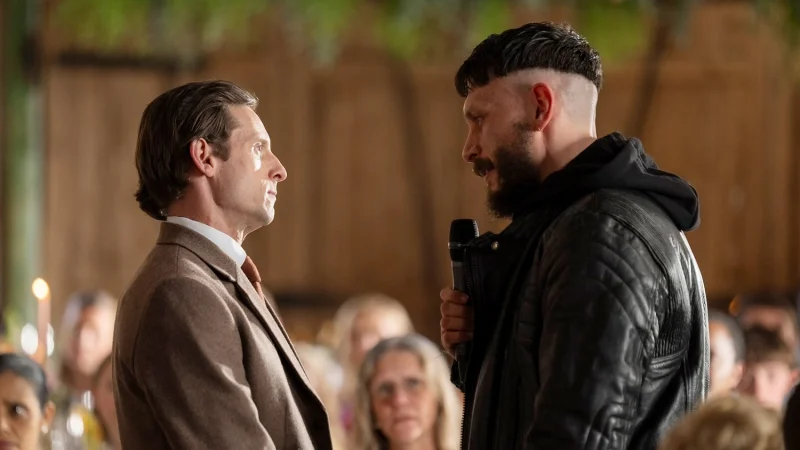
Half Man ends its six-episode run on May 28, closing out a Scottish drama that begins with two boys and ends in a collision of violence, dependence and uneasy brotherhood. The HBO/ co-production follows Niall and Ruben through the 1980s, after their mothers develop a relationship and throw the teenagers together in a bond that mutates from enmity and abuse to friendship, and then something far harder to pin down.
The series is driven by that shift, and by performances that split each character into younger and older selves. Mitchell Robertson plays Niall as a teenager, with Jamie Bell taking over the role in adulthood. Stuart Campbell plays Ruben as a teenager, with Richard Gadd portraying him later. Gadd said there are “two different types of Ruben,” calling him “the calculated version of Ruben” and “the explosive and in-the-moment version of Ruben as well.”
Half Man is the follow-up many viewers will measure against Baby Reindeer, but it is not aiming for the same shape. HBO boss Casey Bloys described it as intense, and the show leans into masculinity, power, sexuality and toxic masculinity with a force that does not leave much room for comfort. The article says there is even, perhaps, a hint of incestuous desire, a suggestion that hangs over the story rather than settling into it.

The premiere makes the point early. Ruben pushes Niall to lose his virginity, procures a woman for the encounter and forces her onto him, then stays to coax Niall through the deed. That scene required two intimacy coordinators. Julie Cullen, who plays Niall’s college flatmate Joanna, said the team encouraged the actors to check in with each other and that, “We had a lot of people who were helping us through anything that we needed.” She added: “We did need it.”
The second episode turns the pressure up again, with Ruben aggressively and repeatedly kicking Niall’s friend’s head in. In real life, Stuart Campbell used a sandbag for the scene. Campbell said it was “a lot scarier on the page than it actually was to shoot,” and that for him the moment reinforces to Niall “a lack of autonomy.”
That mix of brutality and control is what makes Half Man feel less like a simple account of damaged friendship than a study of how domination can pose as loyalty. The show’s support measures mattered because the material did too: the actors were being asked to carry scenes that depend on fear, coercion and emotional exposure, and the production built in checks to keep that from spilling beyond the frame. Campbell said, “[We] became quite close friends quite quickly,” and added, “I could feel safe with him to be vulner” while speaking about working with Bell. That trust, on a set built around difficult material, becomes part of the story itself.
By the time the final episode lands on May 28, Half Man will have done something more than revisit a fraught male friendship. It will have answered its own central question plainly: whether the bond at its center is built on affection, abuse or both. The series says it is all three, and it leaves that contradiction intact to the end.
