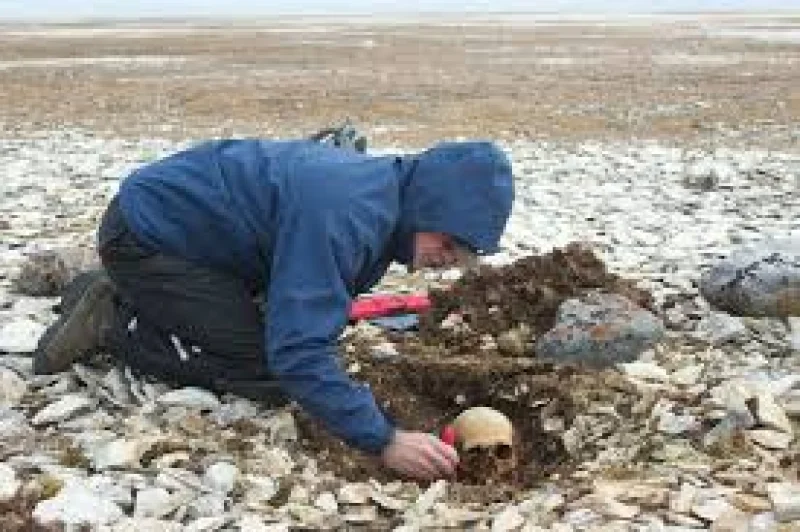
Researchers have identified the remains of three sailors who died aboard HMS Erebus on the doomed Franklin expedition, using DNA testing to match bones recovered from the Arctic with living descendants. The discoveries have brought names back to men who vanished nearly two centuries ago, and they come as previously unseen artefacts from the shipwreck are set to go on display in Wales.
The new work, led by researchers at the University of Waterloo in Canada, is the latest effort to put human identity back onto one of Britain’s most famous naval disasters. The team contacted living descendants of the sailors after matching DNA from remains with family lines, part of a wider project that has now reached 130 families in seven countries.
HMS Erebus was built in Pembroke Dock in 1826 and sailed in 1845 under Captain Sir John Franklin, alongside HMS Terror, in search of the fabled Northwest Passage through the Arctic seas off northern Canada. The expedition carried 128 seafarers. By 1846 both ships were trapped in ice in freezing temperatures, and after two years frozen in place, 24 men had already died.
The desperate end came when 105 survivors tried to walk across the frozen sea pulling heavy sleds in minus 20C temperatures. They were almost 30 kilometres, or 19 miles, from shore. None of them survived the journey. HMS Erebus’s exact fate remained unknown until its wreckage was found in the icy waters of northern Canada in 2014.
Dr Douglas Stenton said the conditions make it hard to imagine the men could have kept going much longer. “We can't imagine that all 105 of those men were healthy enough to pull those very heavy sleds. They were almost 30 kilometres (19 miles) from shore, so the ability to get fresh food wasn't plentiful,” he said.
He said the wider mystery remains just as stark. “Something went seriously wrong. Was it lead poisoning? Was it scurvy? Was it beriberi (disease)? We don't know exactly,” he said.
The identification work also lands against a darker backdrop. A previous study of more than 400 bones found evidence of cannibalism on some bodies, a grim sign of how far the expedition had collapsed before the end. All of the sailors aboard HMS Erebus died after the ship became stuck in ice.
Now the story is returning to the place where the ship was built. Previously unseen artefacts from the wreck, including a bowl and a boot worn by an officer, will go on display at Pembroke Dock Heritage Centre. For Pembroke Dock, the exhibition links the town’s shipbuilding past to one of the Arctic’s most haunting maritime losses, and the new DNA findings ensure that at least three of the dead are no longer anonymous.