


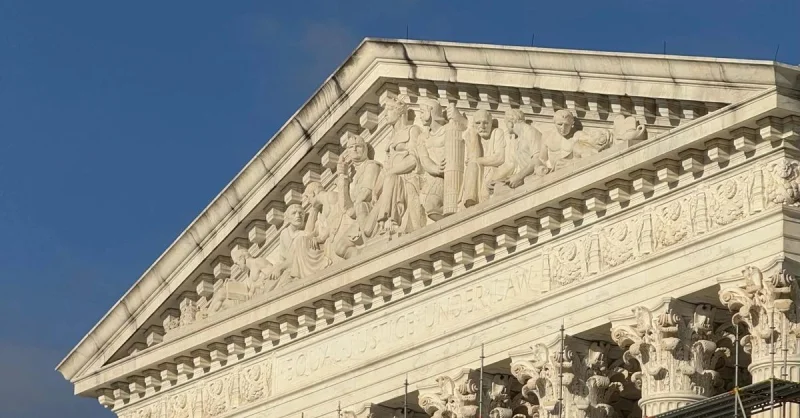
The Supreme Court Of The United States was due to draw fresh attention at 9:30 a.m. EDT on Tuesday, with SCOTUSblog saying it would live blog while the justices were waiting to see whether one or more opinions would be released in argued cases. If opinions did not come, the court was still set to move into its next private conference, where the justices discuss cases and vote on petitions for review.
Orders from that conference were expected Tuesday at 9:30 a.m. EDT, but the court had not yet said when it would next release opinions. That quiet stretch has become its own kind of news in a term where several disputes on the court's doorstep carry consequences well beyond the marble building in Washington.
One of those disputes reaches back to 2004, when the court decided Locke v. Davey and held that states do not violate the First Amendment when they block students seeking devotional degrees from public scholarship programs. The ruling is now back in play through a Virginia scholarship fight, where Bethany Hall lost before the U.S. Court of Appeals for the 4th Circuit and said the result still stung. “It's just quite simply wrong and very sad that our Supreme Court made that decision back then,” Hall said in an interview with World magazine, adding, “$20,000 that I just lost because I'm studying what I feel like I should do with my life.”
The case has broader significance because the court could soon revisit a precedent that has shaped scholarship restrictions for almost 50 years. If the justices take it up, they would be deciding whether Locke still holds in a legal landscape that has shifted since 2004, including the way state aid rules are tested against the First Amendment.

The court's work this week also comes as its justices and lower-court judges are producing opinions with direct reach into other high-stakes fights. On Wednesday, U.S. District Judge John Bates ordered aides to Trump to keep following the Presidential Records Act, granting a preliminary injunction that effectively nullified a Justice Department opinion that the law unconstitutionally intrudes on presidential power. Bates wrote that Congress has the enumerated power to regulate presidential records, a conclusion that put him squarely against the view the department had advanced.
At the same time, recent nominees of President Donald Trump have been leaning on Justice Ketanji Brown Jackson's answer during her 2022 confirmation vetting, when she was asked about the 2020 election results and said it was not proper for her to comment on political matters. On Wednesday, Matthew Schwartz, Trump's nominee to the U.S. Court of Appeals for the 2nd Circuit, said during his own confirmation hearing: “I think the answer that Justice Jackson gave is the only legally and ethically correct one.”
That line of argument shows how a single confirmation exchange can travel far beyond the hearing room and into new nominations. It also underscores how sharply the court's own silence can shape the rest of the legal calendar: the justices may soon speak through opinions, or they may hold back and let the next conference set the pace.
Elsewhere, Costco asked a federal judge on Monday to dismiss a proposed class action over refunds tied to higher prices charged before the Supreme Court struck down import tariffs imposed by Trump. The company said the lawsuit was speculative, that the customer who filed it suffered no harm, and that it had not yet received any refunds at all. It also said it was still unclear when any refunds might arrive or in what amount.
For now, the court's next move is simple enough to describe and hard to forecast: either opinions will emerge, or the justices will keep the docket moving behind closed doors and leave the public waiting for the next announcement.
