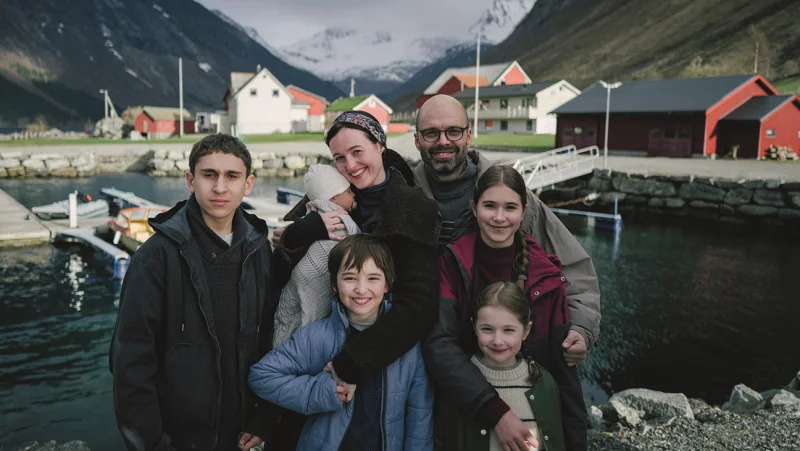
Cristian Mungiu’s Fjord won the Palme d’Or at the 79th Cannes Film Festival, returning the Romanian filmmaker to the top of the Croisette with an English-language drama about a family crisis in Norway. The film stars Renate Reinsve and Sebastian Stan and follows Romanian religious parents who relocate to a small Norwegian village and find themselves accused of child abuse.
The victory gives Mungiu his second Palme d’Or after 4 Months, 3 Weeks and 2 Days in 2007, and it arrives with a commercial boost already in place: Tom Quinn’s indie outfit had picked up Fjord for domestic release ahead of this year’s festival. That makes the film both the year’s biggest Cannes prize winner and one of the few titles to enter the awards season with a U.S. distributor already lined up.
Fjord also matters because it is Mungiu’s English-language debut, a shift for a director long associated with austere Romanian social drama. Neon has now successfully picked the Palme winner for seven years running, extending a streak that has made the company unusually adept at reading the festival’s main competition. The distributor’s track record is part instinct, part timing, and this year it again landed on the eventual winner before the festival’s final verdict.

The win comes in a competition that spread honors widely. Andreï Zvyagintsev’s Minotaur took the runner-up Grand Prix, while directing awards were shared between Javier Calvo and Javier Ambrossi for La Bola Negra and Paweł Pawlikowski for Fatherland. Emmanuel Macchia and Valentin Campagne shared the best actor prize for Coward, Virginie Efira and Tao Okamoto shared best actress for All of a Sudden, Emmanuel Marre won best screenplay for A Man of His Time, and Valeska Grisebach took the Jury Prize for The Dreamed Adventure.
The tension around Fjord is built into the premise itself. Mungiu has made a film about a family uprooted by faith, language and geography, then placed it inside a village where private suspicion becomes public accusation. That is a colder, more confrontational setup than the kind of prestige label that often trails a Palme winner, and it helps explain why the film stood out in a crowded field.
The prize closes a circle for Mungiu. In 2007, he won Cannes’ top award for 4 Months, 3 Weeks and 2 Days, and now he has done it again with a film that stretches him into new language and setting without leaving behind the moral pressure that defined his earlier work. For Cannes, the result is a familiar kind of prestige and a marketable one too: a Palme winner that is already spoken for in the U.S. and backed by a distributor with a streak to protect, as seen in Sebastian Stan porte Fjord, drame de Cristian Mungiu sur la Norvège —