


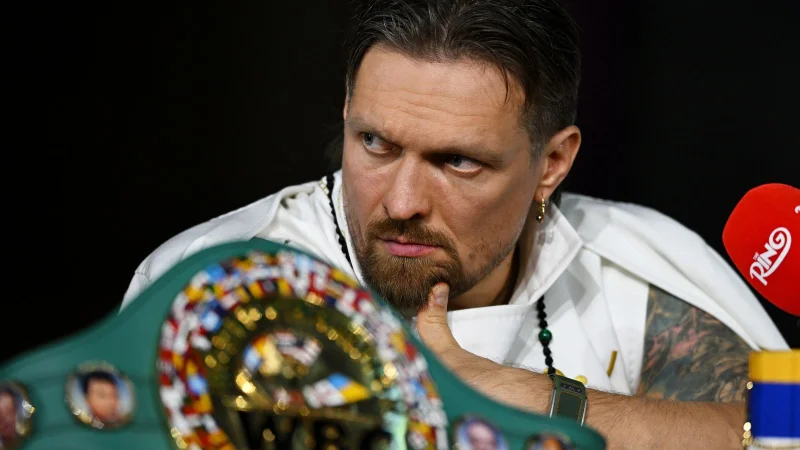
The heavyweight landscape was jolted in February when Turki Alalshikh announced that Rico Verhoeven would challenge Oleksandr Usyk in front of the pyramids of Gizeh on Saturday evening, a fight the WBC, the WBA and the IBF all treated as a world championship bout. The twist was even sharper because the IBF said its title would become vacant if Verhoeven won, while the WBC created a belt and a pendant for the winner instead of putting one of its usual titles on the line.
Agit Kabayel, the WBC interim heavyweight champion, did not hide his first reaction. “I thought it was crazy and that I was going to call the Mexican Mauricio Sulaiman, president of the WBC, to tell him: ‘What is this?’ But I thought about it, I told myself it was a good fight for the fans and that I hoped to face the winner,” he said after the announcement. For a division that still measures itself by its old names, that is the voice of the man waiting in the next line.
The fight arrives wrapped in contradiction. The WBC was founded in 1963 to help bring order to boxing’s world-title picture, but in October 2023 it refused to put its title on the line for Francis Ngannou’s fight against Tyson Fury in Riyadh. This time, it went in the opposite direction and attached championship language to a matchup that many observers would not normally expect a federation to sanction as a title fight.
Verhoeven enters at 37 years old, 1.96 m and 117 kg, with 66 wins and 10 losses in kickboxing and one boxing bout on his record, a knockout win over Janos Finfera in 2014. He was also ranked first by Boxing Scene among the ten least deserving heavyweight challengers in WBC history, a line that underlines how little consensus there is around his place in the division.
Usyk, 39, brings a very different case. At 1.91 m and 105,700 kg, he is unbeaten in 24 fights, with 15 before the limit, and has already won six world heavyweight championships across two wins over Tyson Fury, as well as victories over Anthony Joshua and Daniel Dubois. By any normal sporting standard, that résumé makes him the center of the division, not a backdrop to it.
That is why the Verhoeven fight has drawn so much skepticism even as it carries official trappings. The federation labels, the Cairo setting and the promised prize do not change the basic question hanging over the bout: whether this is a meaningful heavyweight contest or an elaborate event built around a champion who has already settled the sport’s biggest arguments. Kabayel’s answer is practical. If the winner emerges, he wants the next call.
