


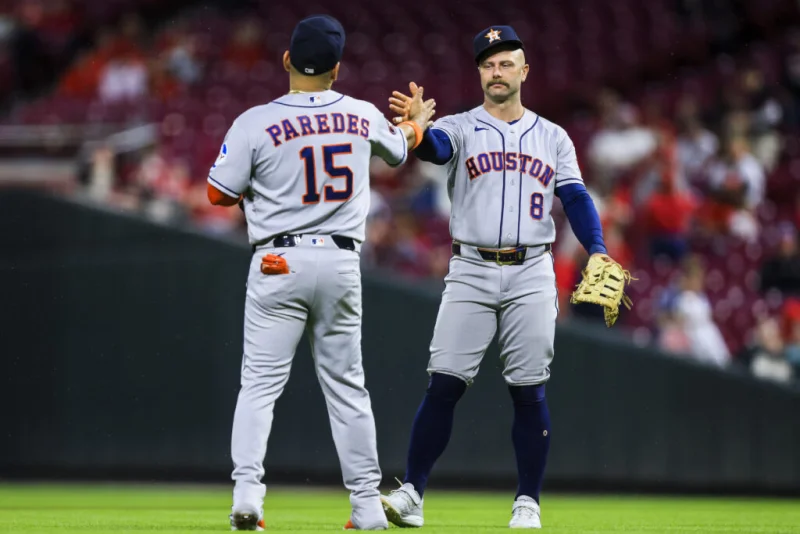
Yordan Alvarez was supposed to be in the designated hitter spot most days. Instead, the Astros reached May 21 with a roster built around him and a wrecked infield around him, a 20-31 record and a season that has slipped toward sell mode faster than anyone in Houston wanted to admit.
The collapse around him began in the offseason, when the club had one version of its infield on paper: Christian Walker at first base, Jose Altuve at second, Jeremy Peña at short and Carlos Correa at third, with Alvarez at designated hitter most days. That plan never survived the calendar. Peña strained a hamstring and went on the injured list in mid-April. Correa shifted to shortstop, Isaac Paredes became the regular third baseman, and then Correa suffered an ankle injury that required season-ending surgery. Nick Allen and Braden Shewmake were used to cover short until Peña returned, but then Altuve went on the injured list once Peña was ready to be activated.
That is the kind of attrition that leaves a club scrambling for coherence, and Houston had little margin for it. The Astros narrowly finished outside the playoff picture in 2025, their first miss since 2016, and they had not finished below.500 since 2014. On May 21, 2026, they were technically five games back of a playoff spot even while sitting at 20-31, a record made uglier by the fact that only the Rockies and Angels were worse.
The context matters because this is not just a bad start. The Astros have been working with limited payroll flexibility in recent offseasons because Jim Crane has wanted to avoid the competitive balance tax, and that caution has shaped nearly everything around the roster. The club needed pitching in the most recent offseason and took gambles on Tatsuya Imai, Ryan Weiss and Mike Burrows. For the most part, those bets have not paid off. Houston also traded Kyle Tucker because of financial concerns, a move that showed how tightly the organization has been managing its resources.
There is no easy rescue sitting in the system, either. The Astros’ farm is widely viewed as one of the weakest in the league, a result of years of winning that thinned the supply of premium young talent and the penalties tied to the sign-stealing scandal. That leaves Houston with veterans carrying the load, and Altuve and Correa fit that description even before the injuries. Both are older players on large contracts, and both have the ability to veto trades, which makes any late-season reshaping more complicated than a simple sell-off on paper.
What happens next is now the real story. All of the players in this infield maze remain under club control for the 2027 season, so Houston is not staring at a one-year patch job. It is staring at a difficult decision about whether to keep trying to push a battered roster built around Alvarez, Altuve and Correa or start making moves that acknowledge how far this season has already drifted away.
