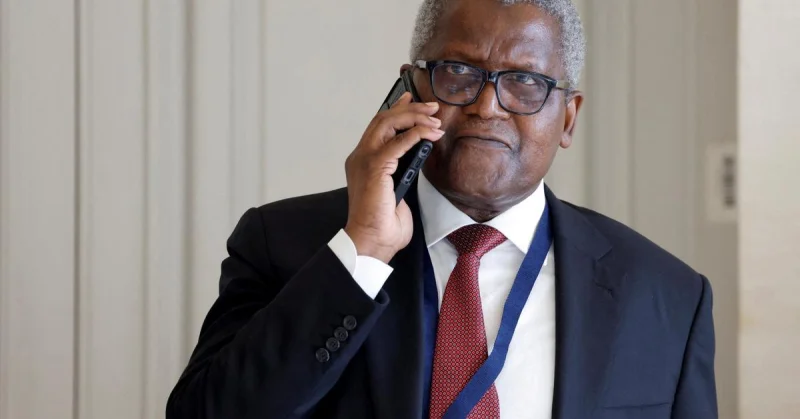
Aliko Dangote is trying to do something that once looked impossible in Nigeria: make the country a steady user of gasoline refined at home, then sell the excess beyond its borders. The billionaire industrialist says his refinery should double in capacity and become the largest in the world, a leap that would deepen his reach in energy at a moment when Nigeria is already consuming locally refined fuel and has no gasoline supply problems.
The shift matters now because it comes after the shock of May 2024, when President Bola Tinubu withdrew gasoline subsidies and devalued the naira. Energy and food prices surged after those policy changes, adding pressure on households and on businesses that depend on imported fuel. Dangote’s refinery, built inside a market once dominated by imports, has become one of the clearest signs that Nigeria’s energy map is changing.
Dangote built his fortune in cement in the early 2000s, helped by a protected market and close ties to government, before moving into food and later into energy and fertilizers. That long drift from one strategic sector to another is now paying off on a larger stage. The new infrastructure has allowed Nigeria to start consuming gasoline refined locally, and Dangote is now pushing to make that setup much bigger.
He says the fight to do so has been tougher than expected. “I never imagined that the oil mafia is worse than the drug mafia,” Dangote said, a line that captured how fiercely established interests resist his push into fuel. The comment also hinted at the tension at the center of his rise: he is not simply building factories, but trying to replace import channels that have long benefited local elites.
That is why the refinery’s next phase is being watched far beyond Nigeria. War in Iran has opened more markets for Dangote in Europe, where airlines buy fuel from him, and it has also widened his opening across Africa. Kenya and Tanzania are among the countries where he is expanding market opportunities, while East African governments compete to be the place where he builds his next refinery.
For supporters, that makes Dangote a rare private actor willing to launch industrial projects that states have neglected for decades. For critics, it raises a different worry: that a single private fortune could accumulate too much power over strategic sectors. Both views can be true at once, and they explain why his expansion is being treated as more than a business story.
What happens next is plain enough. If the refinery scales up as Dangote expects, Nigeria will move further from its old dependence on imported gasoline and closer to a fuel market shaped by one man’s industrial empire. That would not end the fight over who controls Africa’s energy future. It would sharpen it.