


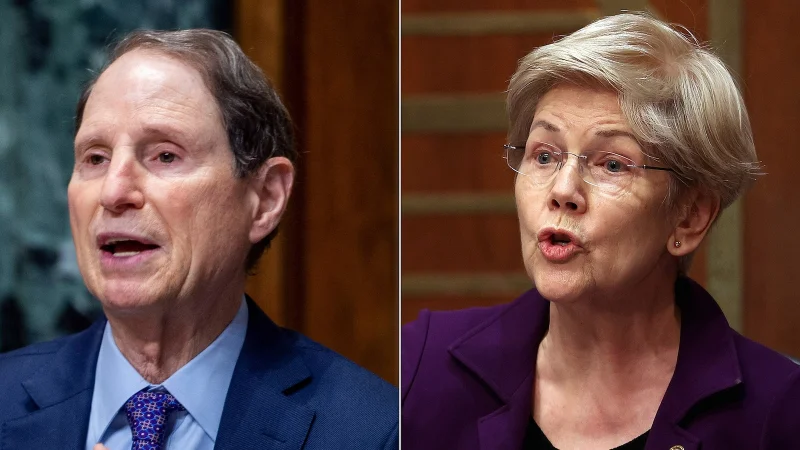
Top Democrats on Thursday demanded answers over the settlement between President Donald Trump and the IRS, a deal that created a nearly $1.8 billion “Anti-Weaponization Fund” and immediately set off alarms on Capitol Hill. In a late-night letter, Senate Banking Committee ranking member Elizabeth Warren and Senate Finance Committee ranking member Ron Wyden pressed Treasury Secretary Scott Bessent and IRS CEO Frank Bisignano for details, calling the taxpayer fund “outrageously corrupt.”
The senators said the arrangement appears designed to route taxpayer money in ways the public cannot see. They wrote that it looks like “a brazen scheme to corruptly dole out taxpayer money to President Trump’s allies and violent insurrectionists,” and warned that the fund could be used to pay people prosecuted for entering or carrying out violent acts at the Capitol on Jan. 6, 2021. They also said the agreement provides for no disclosure of recipients and leaves open the possibility that Trump and his family could draw on the fund with no binding limit. Under the settlement, Trump himself is not allowed to receive money from the fund.

The dispute landed because this was not a routine legal cleanup. The fund stems from a $10 billion lawsuit Trump brought against the IRS after a government contractor pleaded guilty in 2023 to stealing tax information from Trump and other wealthy Americans and leaking it to media outlets in 2019 and 2020. Sources told News that people associated with Trump might be able to file claims, deepening Democratic concern that the money could end up helping his political circle rather than taxpayers. The fund will be led by a five-person commission appointed by the attorney general, and Trump would have the right to remove any member of that commission.
Warren and Wyden said Blanche posted an addendum to the Justice Department’s website on Tuesday that said the IRS was “forever barred and precluded” from “prosecuting or pursuing” examinations or reviews of Trump or “related or affiliated individuals” and businesses arising out of matters currently pending or that could be pending before the IRS or other agencies or departments. The Justice Department later said the addendum applied only “with respect to existing audits, not future.” That distinction matters because the addendum also ends any existing IRS audits of Trump, his family or their businesses, while Democrats say the language leaves too much room for interpretation. The DOJ plans to pull money for the fund from the federal compensation fund, a perpetual appropriation normally used to pay court judgments and settlements.
The timing sharpened the political fight. On Thursday, Senate Republicans punted on plans to move forward with their $70 billion immigration enforcement bill because of concerns over the fund, showing the settlement had already spilled beyond tax enforcement and into broader budget politics. Warren and Wyden are now demanding a full accounting of who can benefit, who decides, and why a taxpayer-backed fund tied to Trump’s IRS lawsuit should be shielded from public disclosure. The unanswered question is no longer whether the deal caused concern; it is whether any version of it can survive scrutiny once lawmakers start asking who gets the money and who controls the list.
