NASA’s Psyche spacecraft swung past Mars last Friday and used the planet’s gravity for a slingshot that put the probe on track for its 2029 arrival at the asteroid Psyche. The flyby was planned as a rehearsal as much as a maneuver, giving ground teams a chance to check the spacecraft’s science gear while it raced through the inner solar system.
The spacecraft passed 2,864 miles from the Martian surface and got a 1,000-mile-per-hour boost, while its orbital plane shifted by about 1 degree relative to the Sun. Don Han said the team had confidence in the flight plan, but watching the Deep Space Network Doppler signal in real time during the flyby was still exciting. He added that the spacecraft is now on course to reach asteroid Psyche in summer 2029.
Psyche launched in October 2023 from Kennedy Space Center, Florida, on a SpaceX Falcon Heavy rocket and is traveling about 2.2 billion miles, or 3.6 billion km, to reach the asteroid in the belt between Mars and Jupiter. The probe uses plasma engines to build up the impulse it needs over time, making the Mars pass a useful midpoint in a six-year journey to a world that remains unexplored up close.

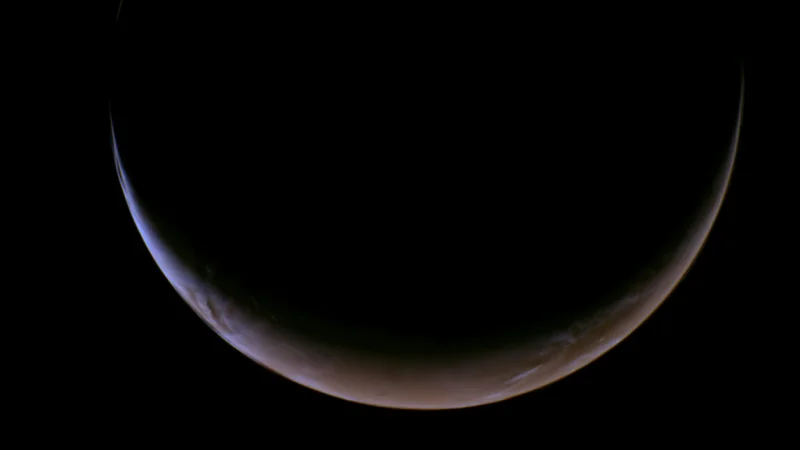
During the encounter, the spacecraft approached Mars from a high phase angle, so the planet appeared as a thin crescent. NASA said the probe also captured Mars images from a rare perspective, including a wide-angle overhead view of the southern polar ice cap. Jim Bell said the spacecraft took thousands of images during the encounter, and that the observations will help scientists calibrate and characterize the performance of the cameras.
Ground teams used the flyby to test a multispectral imager, a gamma-ray and neutron spectrometer, and a magnetometer. The spectrometers were tuned to measure the chemical composition of the Martian surface beneath the spacecraft’s flight path, while the magnetometer may have picked up a signature of the solar wind interacting with Mars’ upper atmosphere or its remnant magnetic field.
The science haul matters, but only so much. Other missions already study Mars full-time, which limits the chance that Psyche’s flyby data will rewrite what is known about the planet. What the pass did do was show that the spacecraft can still execute the measurements and navigation needed for the larger target ahead, and the answer to the test is clear: the cruise, the instruments and the trajectory are all holding together on the long road to Psyche.