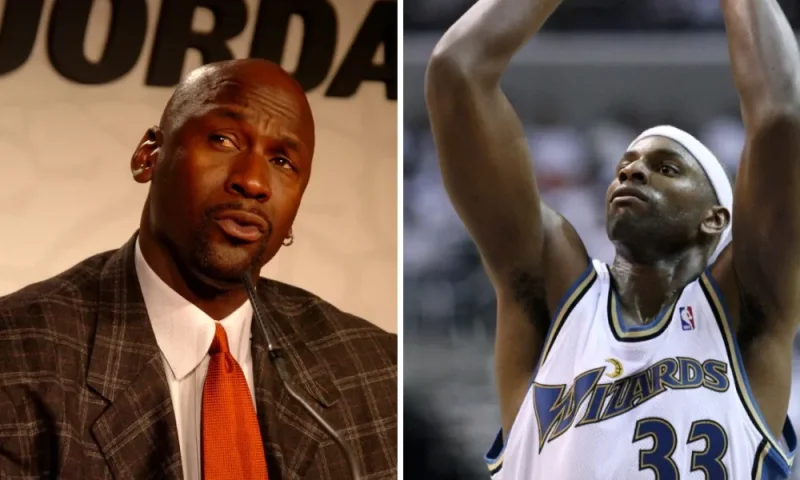
Brendan Haywood’s latest Michael Jordan story has gone viral after the former Washington Wizards center recalled a night out that allegedly ended with him and teammate Jared Jeffries stuck with a $15,000 club bill. The story, shared during a recent podcast appearance, has renewed attention on Jordan’s final NBA years in Washington and the larger-than-life aura he carried even as a 40-year-old teammate rather than a Chicago Bulls champion.
Haywood Says Jordan Left Without Paying
Haywood described going to a club with Jordan, Charles Oakley and other Wizards teammates during his early NBA years. The night began as an unforgettable chance to spend time with one of basketball’s most famous figures, but it quickly became uncomfortable once Jordan and Oakley left.
Haywood said the bill came to about $15,000, a staggering amount for young players who were not yet established NBA earners. He and Jeffries were left behind as the bill arrived, creating what Haywood framed as a panic moment for two younger teammates who had not expected to cover the cost of a celebrity-level night out.
His version of the story includes a broader claim about Jordan’s view of fame and hospitality. Haywood said Jordan believed his presence at a restaurant or club brought enough publicity that he did not always feel obligated to pay in the way ordinary customers would.
Why The Story Is Circulating Now
The clip gained traction because it combines several ingredients that tend to make Jordan stories travel quickly: money, nightlife, teammate culture and the mystique of his Washington years. Jordan’s Bulls career has been dissected for decades, but his time with the Wizards remains a fertile source of anecdotes because younger teammates saw him in a different role.
Haywood was a rookie when Jordan returned to the NBA with Washington in 2001. That put him in a rare position: close enough to observe Jordan daily, but young enough to experience the gap between ordinary rookie life and the orbit around a global icon.
The story also fits a familiar pattern in post-career NBA storytelling. Former players often use podcasts and interviews to revisit private moments from locker rooms, planes, clubs and hotels that never made it into formal game coverage.
Michael Jordan’s Wizards Years Add Context
Jordan played two seasons for the Wizards from 2001 to 2003 after coming out of retirement for a second time. He was no longer the same athlete who dominated the 1990s with the Bulls, but his influence remained enormous.
For Washington’s younger players, having Jordan as a teammate meant daily exposure to one of the most competitive personalities in sports history. Haywood has repeatedly described Jordan as demanding, sharp-tongued and intensely driven, even late in his career.

That background is important because the $15,000 club bill story is not just about money. It also illustrates the unusual hierarchy around Jordan. He was technically a teammate, but he carried the power, celebrity and expectations of a franchise-defining figure.
Haywood Has Shared Other Jordan Anecdotes
The club-bill claim is only one of several Jordan stories Haywood has told over the years. He has described Jordan playing through pain, dominating pickup runs after retirement and setting a ruthless tone in practice.
Haywood has also contrasted Jordan’s leadership style with LeBron James, saying Jordan had less patience for teammates who needed repeated explanation, while James was more likely to teach and guide players through mistakes. That comparison has kept Haywood’s interviews relevant in the ongoing debate over superstar leadership and the NBA’s greatest player conversation.
Those comments do not portray Jordan as a simple villain or hero. Instead, they reinforce the complex image that has emerged from teammates over time: brilliant, competitive, intimidating, charismatic and sometimes difficult to be around.
Why Fans Are Reacting So Strongly
The reaction has been split. Some fans see the story as another funny example of Jordan’s confidence and celebrity power. Others view it as an unflattering account of a superstar leaving younger teammates in an unfair position.
The money figure also gives the story a sharper edge. A $15,000 bill may sound small compared with Jordan’s wealth, but it would have been significant for young players still early in their careers. Haywood’s framing makes the scene easy to picture: two younger teammates suddenly realizing that the icon they came with had already gone.
At the same time, stories like this are difficult to fully verify years later. They often survive through memory, exaggeration, timing and personality. Haywood’s account is being discussed because it is vivid, not because it has been tested like a court record.
What The Story Says About Jordan’s Aura
The lasting point is less about a single bill and more about what it reveals about Jordan’s status. Even in Washington, years removed from his sixth championship, he was not treated like a normal player. His presence changed rooms, drew attention and shaped how people around him behaved.
For Haywood, that meant learning early that life near Jordan came with stories that sounded unbelievable later. For fans, the anecdote adds another layer to the public understanding of Jordan after Chicago: still magnetic, still dominant in personality, and still capable of leaving teammates with a story they would be telling more than two decades later.
The Brendan Haywood Michael Jordan story is now another entry in the long archive of MJ lore. Whether listeners find it hilarious, harsh or simply outrageous, it shows why Jordan’s off-court mythology remains almost as durable as his highlights.