


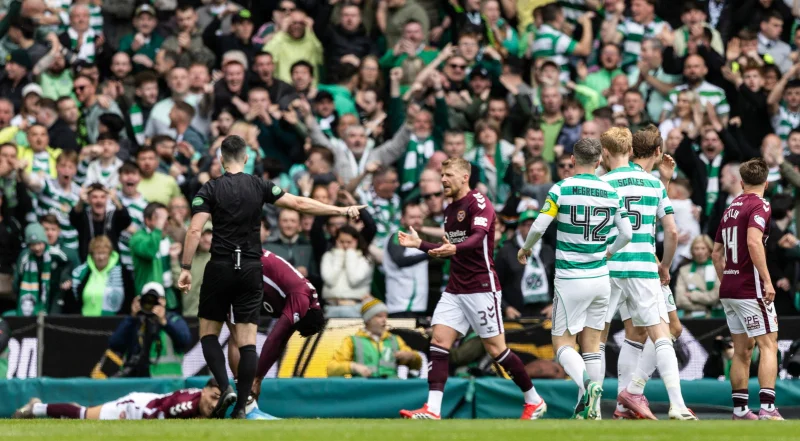
It was Celtic's third goal at Celtic Park that set off the argument, but the claim now under scrutiny is simpler: roughly 30 seconds of the eight minutes of added time were still left when the ball went in on May 16, 2026. In a William Hill Premiership match against Heart of Midlothian in Glasgow, referee Don Robertson had already awarded Celtic a penalty for a handball by Hearts defender Alexandros Kyziridis.
That sequence is what has kept the sfa discussion alive. The fourth official indicated eight minutes of additional time, and the dispute now being argued in some quarters is that the game should have gone on longer before Celtic's third goal changed the scoreline. But the law of the game does not work the way a broadcast graphic does, and the Sky clock is not the law.
The numbers matter because they are the whole case. The claim being debated has been cut down in some corners from a missing minute to about 30 seconds, but the article's answer is blunt: the claim remains absurd. Under Law 7, the fourth official shows the minimum amount of added time decided by the referee. That total can be increased, but it cannot be reduced. The figure on the board is not a casual suggestion; it is the floor.
That matters because football's timing is not a frozen-countdown system. The referee is the official timekeeper under Law 5, which means the person in charge of the match controls the clock that counts for the result. Football does not work like an NBA clock that stops every time something unusual happens. A broadcast timer may help viewers follow the action, but it is not the official match clock and it is not the source of truth when the final seconds are disputed.
Seen that way, the late Celtic goal does not become suspicious simply because it arrived near the end of the added period. The key point is not whether the camera angle or the on-screen timer suggested there was little time left. The key point is that the referee had authority over added time, the fourth official displayed eight minutes, and the law allows that period to run as the referee sees fit. That is why the argument collapses once it is measured against Law 5 and Law 7 rather than against a television overlay.
The wider context is a familiar one in football. Disputed stoppage-time calls often grow louder after the fact, especially when a decisive goal arrives late and the result feels dramatic enough to invite suspicion. Similar misunderstandings over official timing have flared in other public settings too, from the frustration around a Stromausfall to the confusion that can follow a Corte De Agua Santiago outage or a Stromausfall Syke situation, where the visible countdown people rely on is not always the system that actually governs events. In football, the same principle applies: the board shows the minimum, and the referee decides what the match clock means.
That is why the answer to the missing-time claim is straightforward. If eight minutes were indicated, the match could still continue beyond what the broadcast clock suggested, and a goal scored with about 30 seconds left in that added period does not, by itself, prove anything improper. The dispute ends where the laws start: Robertson was the timekeeper, not the screen, and the late Celtic goal stood inside the time the referee was entitled to manage.
