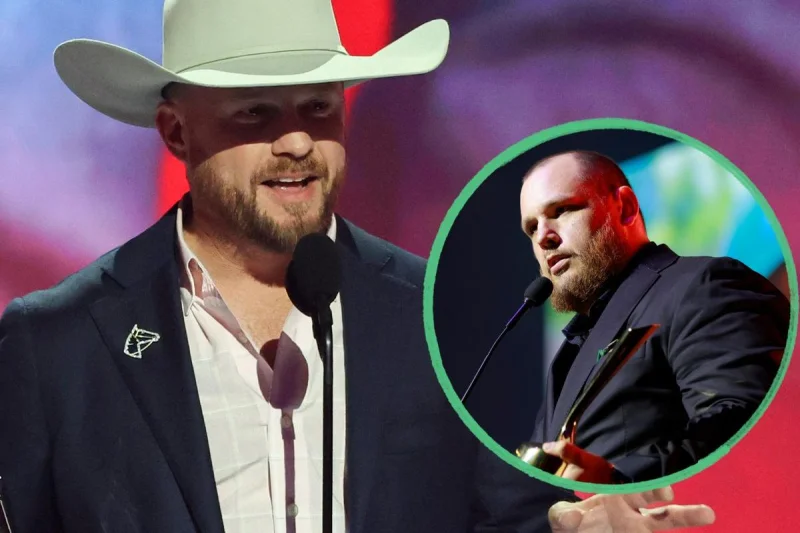
Cody Johnson won his first-ever ACM Entertainer of the Year Award on Sunday, May 17, and used the moment to salute Luke Combs’ perseverance and dedication to country music. Johnson said the tribute was rooted in a night on tour in Australia, when Combs missed the birth of his second son, Beau, who arrived two-and-a-half weeks early.
Johnson said Combs had been hoping to get home in time for the birth, but was still on the road when Beau was born. He said Combs was able to be there virtually, then later found him in the bathroom of an arena, sobbing and devastated after hearing the news. “What’s going on? Who died?” Johnson recalled asking before Combs told him, “My son was born tonight,” and Johnson answered that he was sorry he had missed it but that there was nothing he could do about it.

Johnson said he told Combs he was doing something that would create a legacy for his family for a very long time, and that he should not feel bad. He said he later watched Combs walk out onstage and absolutely kill the show the next night, a moment that gave him a new-gained respect for the singer. Combs later said on the Zane Lowe Show that missing his son's birth was “one of the best and one of the worst days in my life at the same time.”
The exchange landed in the middle of Johnson’s own victory speech, where he framed his win around the split life many touring artists know well. He told the crowd that when he goes home, he turns his phone face down and becomes a husband, a father and a cattle rancher. The remarks tied his first ACM Entertainer trophy to a broader point about what country artists give up on the road, and why the people waiting at home often pay part of the price.
That contrast is what gave the moment its weight: a career award turned into a rare public admission that success onstage often arrives alongside absence off it. Johnson did not just thank a peer. He used the spotlight to argue that Combs’ missed milestone was not a failure, but part of the cost of building something lasting. For Johnson, the award and the story behind it pointed to the same idea — that the road can make the show, but it also takes something from the life around it.