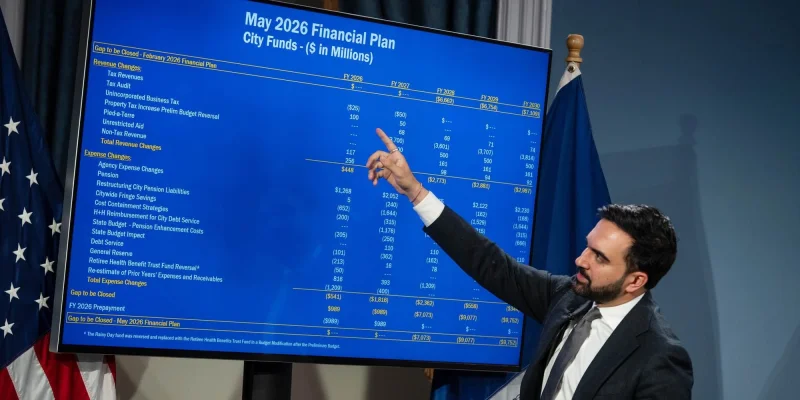
New York City Mayor Zohran Mamdani’s claim that his administration closed a multibillion-dollar budget deficit is facing a fresh test after the city’s chief fiscal watchdog warned that the spending plan may not leave enough protection against a downturn.
Mamdani unveiled a $124.7 billion executive budget this month, saying it erased what he described as a $12 billion gap over two fiscal years without raising property taxes, draining long-term reserves or cutting major city services. The plan marked the first major fiscal blueprint of his administration and immediately became a defining fight over whether New York has stabilized its finances or pushed the hardest choices into the next budget cycle.
Mamdani Says The City Closed Its Budget Gap
The mayor’s budget plan lowered projected spending from the $127 billion preliminary proposal released earlier this year and leaned on a combination of savings, stronger tax projections, state support and policy changes negotiated with Albany.
City Hall framed the proposal as proof that New York could fund core services while avoiding austerity. The administration highlighted continued support for parks, libraries, public housing, street safety and social programs, while saying the budget avoided a property tax increase that had drawn sharp resistance from homeowners, lawmakers and fiscal monitors.
The proposal also backed away from an earlier idea to use reserve funds more aggressively. That shift mattered because watchdogs had warned that dipping into rainy-day accounts during a period of economic uncertainty could leave the city exposed if revenues fell.
Still, the budget is not final. The mayor and City Council must reach an adopted budget by June 30, and the final agreement may change spending levels, savings targets and agency allocations before the new fiscal year begins July 1.
Watchdogs Warn The Deficit Question Is Not Fully Settled
The latest concern centers on whether Mamdani’s balanced-budget claim rests on assumptions that could prove difficult to sustain. New York City Comptroller Mark Levine has warned that the city needs deeper reserves, including billions more in savings, to prepare for a possible economic shock linked to artificial intelligence and broader labor-market disruption.
The comptroller’s office has urged the city to build reserves equal to 16% of annual tax revenue. Its latest analysis suggests the current cushion remains short of that standard, even after the administration’s effort to avoid drawing down long-term reserves.
That warning does not mean the city budget is legally unbalanced. New York City is required to adopt a balanced budget, and Mamdani’s executive plan meets that requirement on paper. The dispute is about the quality and durability of that balance: whether recurring revenues are strong enough to cover recurring expenses, and whether the city has enough cash set aside if Wall Street, real estate, tourism or high-income tax revenue weakens.

Why AI Is Now Part Of The Budget Debate
Artificial intelligence has become a budget issue because New York’s tax base depends heavily on industries with large numbers of white-collar jobs. Finance, legal services, media, advertising, technology, consulting and corporate management all contribute significantly to income-tax, business-tax and real estate revenue.
If AI tools boost productivity without major job losses, the city could benefit from stronger profits and higher economic output. If they displace workers or slow hiring in high-paying sectors, New York could face weaker income growth, falling tax receipts and higher demand for social services.
That uncertainty is why fiscal officials are pressing for a larger reserve cushion. The concern is not that AI has already created a recession in the city, but that budget planning must account for a wider range of risks than a normal growth forecast captures.
The State Budget Remains A Key Variable
Mamdani’s plan also depends in part on help from Albany. State budget negotiations have included measures affecting New York City schools, labor costs, aid formulas and local fiscal flexibility. Any delay or change at the state level can affect the city’s own budget math.
That dependency has become a political vulnerability. Supporters argue that the mayor successfully forced state leaders to take responsibility for costs that directly shape city finances. Critics argue that relying on Albany makes the city’s budget less secure because state lawmakers face their own spending pressures and late-stage negotiations can shift quickly.
The state role is especially important for education, health care, housing and migrant-related costs, which remain among the biggest drivers of pressure on the city’s financial plan.
What It Means For New Yorkers
For residents, the budget fight is not only about accounting. It affects whether agencies can maintain library hours, park maintenance, housing programs, sanitation service, public safety staffing, school support and street repairs without sudden cuts later.
Mamdani’s political challenge is to prove that his administration can fund progressive priorities while convincing investors, bond markets, watchdogs and moderate lawmakers that the city is not relying on temporary fixes. His critics will keep pressing on whether savings are recurring, whether revenue forecasts are too optimistic and whether labor, shelter and special education costs are fully funded.
The next major test comes before the June 30 deadline, when the mayor and City Council must turn the executive proposal into a final adopted budget. Until then, the central question remains open: Mamdani has produced a balanced plan, but New York’s longer-term deficit debate is far from over.