


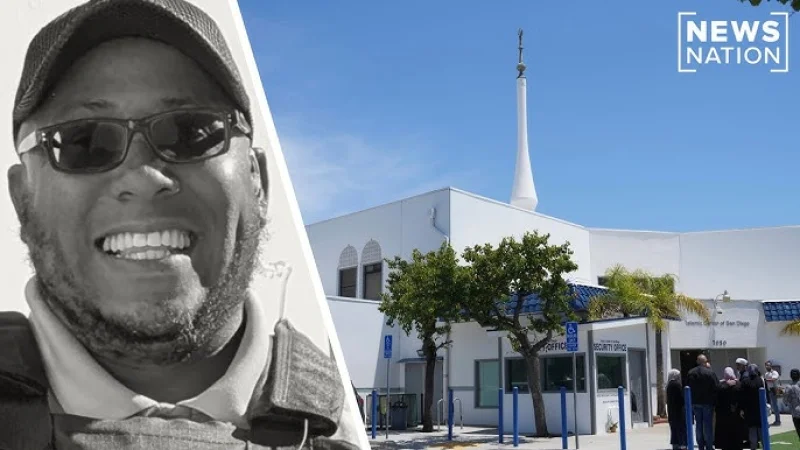
Three worshippers and community members were killed Monday afternoon in a shooting at the Islamic Center of San Diego, where police say two teenage gunmen opened fire before dying from apparent self-inflicted gunshot wounds nearby. The attack in the Clairemont neighborhood has drawn a major local and federal investigation, renewed security at houses of worship and grief across San Diego’s Muslim community.
What Happened At The Islamic Center Of San Diego
San Diego police received the first active-shooter call at about 2:43 p.m. ET on Monday, May 18, after gunfire erupted at the Islamic Center of San Diego on Eckstrom Avenue. Officers arrived within minutes and found three adult victims dead outside the center.
Police then entered the mosque and the adjacent school area to search for the shooters. The threat was later declared contained after two suspects were found dead in a vehicle a short distance away. Children inside the center’s school were safe, a detail that has become central to how authorities and community members are describing the response inside the building.
The Islamic Center is one of the region’s most prominent Muslim institutions, serving as a mosque, school and community hub. The shooting shattered a routine weekday at a place where families, students and worshippers gather daily.
Cain Clark And Caleb Vazquez Identified As Suspects
Investigators have identified the suspected shooters as Cain Clark, 17, and Caleb Vazquez, 18. Authorities say the two teens appear to have met online and are being examined for possible links to violent extremist ideology.
Police and federal investigators are reviewing writings, digital material and video connected to the attack. Early findings point to broad hate rhetoric involving race and religion, with the case being treated as a potential hate crime. Officials have not said that every element of motive has been settled, and investigators are still working through online accounts, devices and the suspects’ path to the mosque.
Some public confusion has surrounded the spelling of one suspect’s name, with “Caleb Vasquez” and “Caleb Velasquez” circulating online. The name being used in official and law enforcement briefings is Caleb Vazquez.
Victims Remembered As Protectors And Pillars
The victims have been identified as Amin Abdullah, Mansour Kaziha and Nadir Awad. Abdullah, a 51-year-old security guard at the Islamic Center, is being widely credited with saving lives after he confronted the gunmen and helped trigger lockdown procedures.
Police Chief Scott Wahl has said Abdullah’s actions helped people inside the mosque and school take cover before the attackers could reach them. About 140 children were inside the center at the time, making the rapid lockdown one of the most consequential parts of the response.

Kaziha, 78, was remembered as a respected mosque elder. Awad, 57, was described as a neighbor and working man whose life was taken during the attack outside the center. Their deaths have left families and worshippers mourning not only three individuals, but also the sense of safety that religious communities depend on.
Why Police Are Investigating A Hate Crime
The hate-crime investigation is focused on evidence found after the shooting, including writings and symbols tied to extremist views. Authorities are also examining whether the suspects drew inspiration from prior mass attacks, including violence aimed at religious communities.
The case reflects a growing concern among law enforcement agencies: young attackers becoming radicalized in online spaces that glorify mass violence, mix racist and anti-religious ideology, and encourage copycat attacks. Investigators are looking at how the suspects communicated, what they consumed online and whether anyone else had knowledge of the plan.
That work is separate from the immediate public-safety question, which police say has been resolved. The active-shooter threat at the mosque ended Monday, but the broader investigation into planning, motive, weapons and digital influence remains active.
Todd Gloria Says San Diego Will Stand With Muslim Community
Mayor Todd Gloria condemned the attack and said hate has no place in San Diego. City officials have emphasized solidarity with the Muslim community while police maintain heightened awareness around religious sites.
The shooting has also renewed conversations about security at mosques, synagogues, churches and schools. For many religious communities, the attack reinforces the difficult balance between remaining open to worshippers and strengthening protection against targeted violence.
Community leaders have urged the public not to spread graphic footage, false suspect claims or unverified rumors. That warning is especially relevant because extremist attackers often seek attention online, and reposting violent material can amplify the message they intended to spread.
What Happens Next In The San Diego Shooting Investigation
The next phase of the investigation will center on digital evidence, weapons tracing, the suspects’ movements before the attack and the full sequence of events inside and outside the Islamic Center. Federal civil rights investigators are expected to remain involved because of the suspected hate-crime element.
For families in Clairemont and across San Diego, the immediate focus is on mourning the victims and supporting children who survived a terrifying lockdown. Funerals and vigils are expected to keep attention on Abdullah, Kaziha and Awad rather than the attackers.
Police have not announced any continuing active-shooter threat tied to the mosque. The larger question now is how two teenagers came to carry out an attack on a religious community — and whether the warning signs in their online and offline lives were missed before three men were killed.
