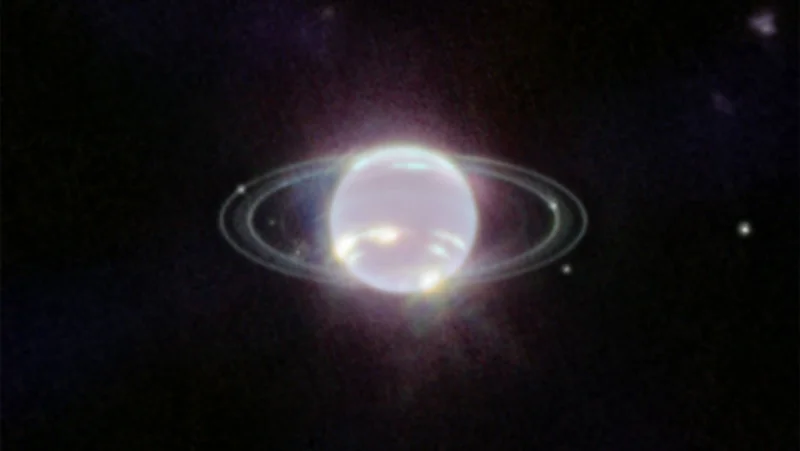
A new study suggests Neptune’s moon Nereid may not be a stray from the Kuiper Belt after all. Instead, it may have been born in a steady, circular orbit around Neptune before a violent encounter with a Pluto-sized body sent it into the wide, stretched path it follows today.
Researchers published the work in Science Advances on May 20, 2026, and the picture they sketch is brutal: the same encounter that may have flipped Nereid onto its current elongated orbit could also have ejected or pulverized every one of its sibling moons. Matthew Belyakov, one of the study’s authors, put the idea bluntly: “Maybe it got perturbed outward, rather than kicked inward,” and “Nereid is that last remaining signature of the original satellite system.”
The new paper matters because Nereid has long been treated as an irregular satellite, and possibly a captured Kuiper Belt object. Neptune’s largest moon, Triton, already sits at the center of a long-running origin story. It orbits backward, makes up more than 99 percent of the mass of all Neptune’s moons combined, and is thought to have come from the Kuiper Belt billions of years ago, disrupting the rest of the moon system when Neptune captured it. Most of Neptune’s other moons are small, rubbly bodies that orbit much closer in.
Belyakov and colleagues tried to test whether Nereid really belongs to that captured family. They compared James Webb Space Telescope observations of Nereid’s makeup with those of Kuiper Belt objects, and Nereid did not match any of the objects in their comparison set. They then ran computer simulations of Triton’s chaotic arrival using hundreds of different masses and orbits for Neptune’s original moons. None of the simulations reproduced Nereid’s exact present-day orbit, but about 20 percent of them produced a moon on a Nereid-like path without destroying Triton.
That combination leaves Nereid looking less like an immigrant and more like a survivor. It is brighter, larger, more eccentric and closer to Neptune than other irregular satellites in the solar system, and Belyakov said, “Nereid always is an outlier,” a description that fits both its orbit and the way astronomers have been forced to think about it. The best image of the moon remains the one Voyager 2 captured in 1989, when it was only about five pixels across.
That is part of the problem. Astronomers are still working with a barely resolved target while trying to reconstruct events that happened billions of years ago, so every new observation carries disproportionate weight. NASA’s James Webb Space Telescope gave researchers their first serious modern look at Neptune and its rings and inner moons in 2022, but even that leaves Nereid as a difficult object to read from afar.
The study does not close the case so much as shift it. If Nereid formed around Neptune and was then scattered by the arrival of Triton, it could preserve the last surviving trace of Neptune’s original moon system. That makes the next step obvious, even if it is still far off: “That’s the next frontier, missions to the ice giants,” Belyakov said. Until then, Nereid remains the odd moon out, and maybe the only witness left to a moonpocalypse at Neptune.