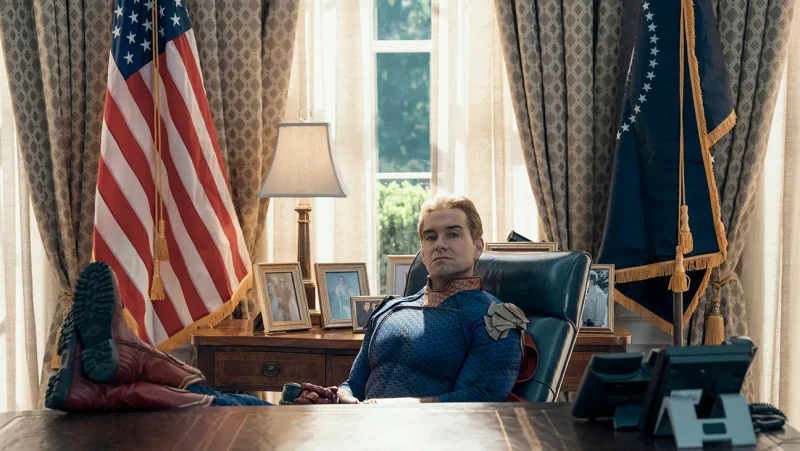
“The Boys” has reached its series finale, with Season 5 Episode 8 ending the main Prime Video drama after five seasons, 40 episodes and a final confrontation built around Homelander, Billy Butcher and the future of Vought’s supe-dominated America.
The final episode, titled “Blood and Bone,” arrived Wednesday, May 20, at 3 a.m. ET. It delivered the long-anticipated answer to the show’s central question: whether Homelander could be stopped, and what price the surviving members of the Boys would pay to end his rule.
The Boys Season 5 Episode 8 Release Date And Time
“The Boys” finale was released on Wednesday, May 20, at 3 a.m. ET on Prime Video, following the platform’s simultaneous global release pattern. The episode also received a limited 4DX theatrical screening in the U.S. and Canada on Tuesday, May 19, giving some fans an early big-screen look at the conclusion before it reached streaming.
The finale capped a final season that began in April and moved weekly toward its endgame. Season 5 placed Homelander in his most powerful political position yet, with the country under authoritarian control and the remaining resistance forced into a desperate final push.
For viewers searching for the last episode, “The Boys” Season 5 Episode 8 is now available as the series finale rather than a standard season closer. There is no Season 6 planned for the flagship show.
Does Homelander Die In The Boys?
Yes. Homelander dies in the series finale after losing the powers that made him nearly impossible to defeat.
The climactic sequence turns on Kimiko, whose altered ability strips Homelander of his strength, invulnerability and laser vision. Once powerless, Antony Starr’s character is left exposed in a way the series had spent years building toward. Billy Butcher then kills him with a crowbar, ending the show’s defining rivalry in a brutal, grounded fight rather than a superhero spectacle.
The choice reframes Homelander’s end around fear, not grandeur. For much of the series, he presented himself as untouchable: a celebrity, corporate weapon, political symbol and self-declared savior. The finale removes that mythology before killing him, making his last moments less about power than panic.
How Homelander Lost His Powers
Homelander loses his powers through Kimiko’s new power-suppressing blast, a development tied to the final season’s larger fight over Compound V, the Godolkin virus and attempts to neutralize supes without destroying the world around them.
The plot gives Kimiko a central role in the last battle. Rather than making Homelander fall only through Butcher’s rage, the finale makes his defeat a team result, with years of damage, experimentation and survival converging in one decisive moment.

That detail also matters for the wider universe. Power removal has long been one of the franchise’s most consequential ideas because it challenges the foundation of Vought’s control. In the finale, Homelander’s death is not just the end of one villain; it is proof that the seemingly permanent hierarchy around supes can be broken.
Billy Butcher’s Ending Carries The Heaviest Cost
Homelander is not the only major character to die. Billy Butcher also dies after Hughie stops him from releasing a supe-killing virus that would have wiped out powered people broadly, not just the most dangerous figures.
That final turn keeps Butcher from becoming the thing the group spent years fighting. His hatred of supes, rooted in grief over Becca and sharpened by every betrayal, remains central to the show’s moral conflict until the end. Hughie’s decision to shoot him is presented as both an act of prevention and a devastating farewell.
The episode also confirms the emotional fallout from Frenchie’s death in the penultimate episode. Tomer Capone’s character remains one of the season’s most painful losses, and Kimiko’s ending is shaped by grief as much as survival.
Gen V, The Boys Mexico And The Franchise’s Future
The flagship series is over, but the larger universe is not. “Gen V” remains part of the continuing franchise, and its characters have become more closely connected to the final season’s mythology. The finale leaves room for that younger generation to inherit some of the moral and political questions the original series leaves behind.
A separate Mexico-set spinoff has also been in development, though it remains further away and has not replaced the main show on the immediate release calendar. Another planned prequel, centered on Vought’s earlier history, is expected to extend the franchise beyond the Homelander era.
That means the ending closes the story of Butcher, Hughie, Annie, Homelander and the original team, but not the world they changed. Vought’s influence, the politics of Compound V and the consequences of supe power remain open territory.
The Boys Ending Leaves A Violent But Clear Final Statement
The series finale does not soften the show’s identity. It remains violent, cynical, profane and politically pointed through its final hour. But it also gives the central characters defined endpoints rather than leaving the main conflict suspended for another season.
Hughie and Annie move toward a quieter life, with parenthood ahead. Mother’s Milk finds a measure of personal stability. Kimiko carries Frenchie’s memory forward. Butcher dies after saving the world from Homelander and then being stopped from committing mass murder himself.
For a series built on distrust of power, celebrity and corporate mythology, the final episode lands on a simple conclusion: no one is untouchable, not even Homelander.