


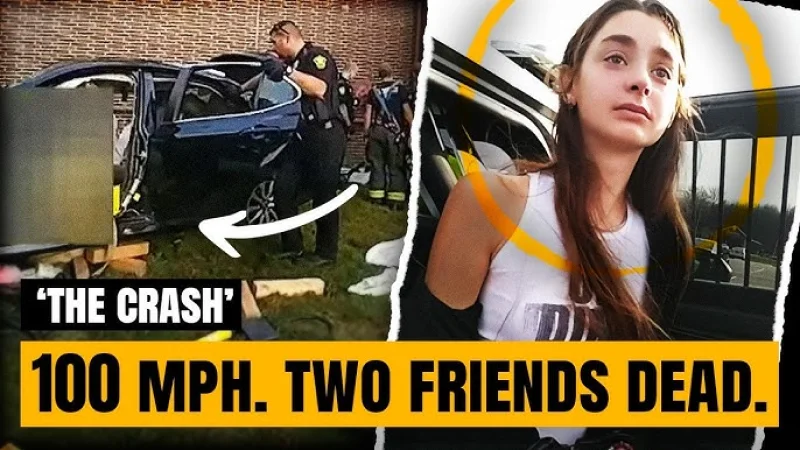
Mackenzie Shirilla’s case is back in the national spotlight after Netflix released “The Crash,” a true-crime documentary revisiting the 2022 Strongsville, Ohio, collision that killed Dominic Russo and Davion Flanagan and led to Shirilla’s murder conviction.
The film, released May 15, has renewed public attention on where Shirilla is now, why the crash became a homicide case, and what remains unresolved as her family continues to challenge the conviction.
The Crash Reopens A Case That Divided Strongsville
“The Crash” reconstructs the July 31, 2022, wreck that initially appeared to be a devastating teenage accident. Shirilla, then 17, was driving with Russo, her boyfriend, and Flanagan, a friend, when her vehicle struck a brick building at high speed in Strongsville. Russo and Flanagan died at the scene. Shirilla survived with serious injuries.
Investigators later treated the case as intentional rather than accidental. Prosecutors argued Shirilla deliberately drove into the building after a turbulent relationship with Russo. Her defense rejected that theory, maintaining there was no proven intent to kill and raising questions about what happened inside the car in the seconds before impact.
The documentary gives the case a wider audience by pairing trial evidence with interviews from relatives, friends, investigators and Shirilla herself. It also highlights why the crash continues to generate debate: the courtroom found criminal intent beyond a reasonable doubt, while Shirilla and her supporters continue to insist the wreck was not a planned act.
Where Mackenzie Shirilla Is Now
Shirilla, now 21, is incarcerated at the Ohio Reformatory for Women in Marysville. She is serving an aggregate sentence of 15 years to life in prison and is scheduled to become eligible for parole in 2037.
Her sentence followed a 2023 bench trial in Cuyahoga County, where she was convicted of multiple charges, including murder, felonious assault and aggravated vehicular homicide. The judge described the crash as intentional and imposed two concurrent life terms with parole eligibility after 15 years.
Her direct appeal was rejected, and a later postconviction filing was also dismissed. In March 2026, an Ohio appellate court affirmed the dismissal of that petition, finding it was untimely under the state’s postconviction deadline rules. That ruling left the conviction and sentence intact.
Why The Strongsville Crash Became A Murder Case
The prosecution’s case centered on the vehicle’s path, speed and data from the moments before impact. Trial evidence showed the car was traveling near 100 mph before it hit the building. Investigators pointed to the accelerator being depressed and no braking in the final seconds as key evidence supporting intent.
The state also presented the relationship between Shirilla and Russo as a major part of the motive theory, arguing that their conflict had escalated before the crash. Evidence about prior behavior, social media activity and the events leading up to the wreck became central to the trial.
The defense countered that the evidence did not exclude other explanations. Shirilla has said she does not remember the moments before the collision. Her family and legal team have raised the possibility of a medical episode, including discussion of POTS, a condition that can involve dizziness, fainting or rapid heart rate. That claim remains disputed in the legal record and did not alter the trial outcome.
Netflix’s “The Crash” Adds A Prison Interview
One reason the documentary has drawn attention is Shirilla’s on-camera prison interview. She did not testify at trial and had not publicly addressed the case in the same way before the film.
In the documentary, Shirilla maintains that she was the driver in a tragedy but rejects the label of murderer. The interview was conducted with her lawyer present, and the film frames her account against the prosecution evidence and the views of the victims’ families.
The film also connects the case to broader true-crime interest. Viewers searching for “Mean Girl Murders,” “Killer Cases,” “The Crash documentary” and “crash Netflix” have been drawn back to earlier television coverage and renewed discussion of the Strongsville crash.
Fallout Extends Beyond The Documentary
The renewed attention has already produced consequences outside the courtroom. Shirilla’s father, Steve Shirilla, was placed on administrative leave from his teaching position after the documentary’s release. The move followed backlash tied to his participation in the film and public comments supporting his daughter.
That development underscores how the case remains raw in northeast Ohio. For the families of Russo and Flanagan, the documentary revives the deaths of two young men whose lives ended in a violent crash. For Shirilla’s family, the film is part of an ongoing effort to argue that the conviction did not capture the full truth.
The legal status, however, has not changed. Shirilla remains convicted, imprisoned and years away from parole eligibility. The next phase of the case will depend on whether her legal team pursues additional challenges and whether any new evidence is accepted by the courts. Until then, “The Crash” has not reopened the case legally, but it has returned the Strongsville tragedy to public view.
