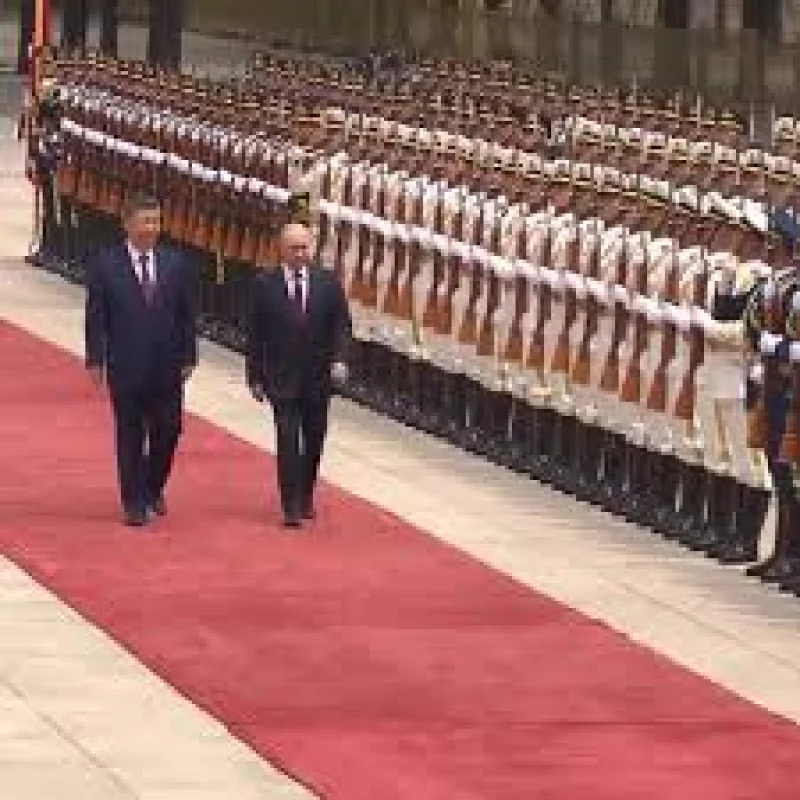
Xi Jinping welcomed Vladimir Putin on Wednesday morning in the Great Hall of the People in central Beijing, setting off a day of pageantry and hard-nosed diplomacy that ended with the two leaders signing a fresh batch of documents. Chinese soldiers stood in position as a military band played the Russian and Chinese national anthems, while children waved both countries' flags and shouted, “Welcome, welcome!”
The meeting began in a shorter narrow format session with fewer delegates, where the most sensitive issues were handled behind closed doors. It later expanded into a wide format meeting with delegations that ran until about 2pm local time, before Xi and Putin attended a signing ceremony covering technology, trade, scientific research and intellectual property. Chinese state media said one of the documents extended the China-Russia treaty of good neighbourliness and friendly cooperation, first signed 25 years ago.
Xi used the talks to project confidence in a relationship he said was at the “highest level of comprehensive strategic partnership.” He called on both countries to oppose “all unilateral bullying” in the international arena and warned that the world risked sliding back into the “law of the jungle.” On the Middle East, he said further hostilities were “inadvisable” and that a “comprehensive ceasefire is of utmost urgency.”
Putin matched the tone, saying ties had reached an “unprecedentedly high level” and that Moscow remained a “reliable energy supplier” despite the strain of the wider geopolitical crisis. He invited Xi to visit Russia next year. Xi, in turn, is scheduled to host Putin for tea in Zhongnanhai, a ritual that will again put the personal side of the relationship on display after their last meeting in Beijing in May 2024, when the pair also shared tea and chatted without ties.
The choreography mattered because the summit came only days after Xi hosted Donald Trump in the same location in Beijing last week, underlining how central the capital has become to China's high-level diplomacy. It also came as Russia's sanctions-hit economy faces the growing cost of Moscow's war in Ukraine, making trade and investment likely to dominate Putin's practical agenda alongside the symbolism. China is Russia's largest trading partner and buys almost half of Moscow's oil exports, giving Beijing unusual leverage even as it keeps public backing for Moscow's leadership.
There was another sign of that closeness before the talks even began. China's foreign minister, Wang Yi, greeted Putin when he landed in Beijing on Tuesday evening, and he is expected to hold talks with Russian Foreign Minister Sergei Lavrov. The handshakes, the tea and the signed papers all point in the same direction: Beijing and Moscow are still tightening a partnership that is now being tested by war, sanctions and a global scramble for energy and influence.