


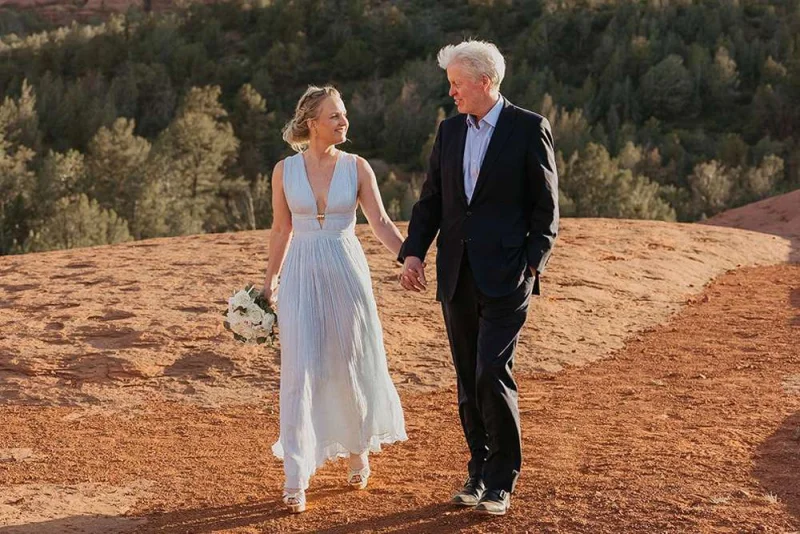
Charles Spencer, the 9th Earl Spencer and younger brother of Princess Diana, has married archaeologist Cat Jarman in a private ceremony in Arizona. The wedding, held Friday, May 15, near Sedona’s Cathedral Rock, marks Spencer’s fourth marriage and Jarman’s second, bringing a closely watched relationship into a new public phase after years of professional collaboration, personal scrutiny and legal fallout from Spencer’s previous divorce.
Private Arizona Ceremony Breaks With Aristocratic Tradition
The ceremony was intimate and deliberately low-key, far removed from the grand country-house imagery often associated with the Spencer family. The couple married against the red-rock landscape near Sedona, choosing a setting known more for natural drama than aristocratic formality.
Jarman wore a pale blue dress rather than a traditional white bridal gown, while Spencer chose a dark suit with a relaxed shirt. The styling underscored the tone of the event: personal, informal and shaped around the couple rather than the conventions attached to an English title.
The wedding also gives Jarman the title Countess Spencer. That change will draw public interest because of the Spencer family’s long association with British society and royal history, but the couple’s own public image has been built less around aristocratic life than shared work in history, archaeology and broadcasting.
From Professional Collaboration To Marriage
Spencer and Jarman first connected through their mutual interest in history. Their relationship began professionally after Spencer engaged with Jarman’s work on Viking history, including her book River Kings. She later became involved in archaeological work connected to Althorp, the Spencer family estate in Northamptonshire.
The two also co-host The Rabbit Hole Detectives, a history podcast built around objects, stories and overlooked details from the past. That public collaboration helped make their partnership visible before their romance was formally confirmed.
Their relationship became public in 2024 after Spencer and his third wife, Karen Spencer, separated. Spencer has described his bond with Jarman as rooted in laughter, shared curiosity and the ability to be more fully himself. Jarman has also presented the relationship as one that grew gradually from professional respect into personal commitment.
Wedding Follows Spencer’s Divorce From Karen Spencer
The timing of the wedding has drawn attention because Spencer’s divorce from Karen Spencer was finalized in December 2025. The couple had been married for more than a decade and shared a daughter. Their separation became public in 2024 and quickly moved beyond a private family matter because of the prominence of the Spencer name and the legal disputes that followed.
Spencer was previously married to Victoria Lockwood, Caroline Freud and Karen Gordon. He has seven children from his earlier marriages, including adult children from his first marriage and younger children from later relationships.

The Arizona wedding therefore represents both a personal reset and a high-profile family development. Spencer’s marriages have long been covered because of his connection to Diana, Princess of Wales, but this ceremony appears to have been designed to avoid spectacle and limit public intrusion.
Legal Dispute Added Scrutiny Before The Wedding
The relationship between Spencer and Jarman became entangled in the public breakdown of his previous marriage. Jarman filed a legal claim against Karen Spencer involving the alleged disclosure of her multiple sclerosis diagnosis. The dispute added a sensitive medical privacy issue to an already closely watched divorce.
That case was settled in 2025, before the wedding. The settlement did not erase the public attention surrounding the matter, but it did remove one of the more contentious legal issues from the couple’s path as they moved toward marriage.
The episode also shaped public understanding of Jarman beyond her academic career. While she is known professionally as a Viking Age specialist, author and editor, the lawsuit placed her private health information and personal life under unusual scrutiny. The wedding now shifts the focus back toward the couple’s future rather than the conflict that surrounded the earlier transition.
Who Is Cat Jarman?
Cat Jarman is a Norwegian archaeologist, author and broadcaster whose work focuses on the Viking Age, bioarchaeology and early medieval history. She earned a doctorate in archaeology and has become known for making historical research accessible to general audiences through books, television work and podcasting.
Her published work includes River Kings and The Bone Chests, both of which reflect her interest in how objects, migration, burial evidence and scientific analysis can reshape understanding of the past. She has also worked in editorial and public-history roles, expanding her profile beyond academic research.
Jarman has two sons from her previous marriage. Her new role as Countess Spencer will inevitably increase public attention, but her professional identity is already well established outside the aristocratic world she has now joined.
A New Public Chapter For The Spencer Family
The marriage comes at a moment when public fascination with the Spencer family remains strong, especially because of its connection to Princess Diana and to Althorp, where Diana is buried. Charles Spencer has often occupied a complicated public position: part historian, part aristocrat, part guardian of a family legacy that remains deeply tied to modern royal memory.
This wedding is not a royal event, but it carries cultural interest because of that wider family context. It also reflects a more modern version of aristocratic visibility, shaped by podcasts, social media, personal reinvention and public discussion of private hardship.
For Spencer and Jarman, the immediate significance is simpler. Their Arizona ceremony formalizes a relationship that began in scholarship and collaboration, endured public scrutiny and now moves into marriage. The couple’s next chapter will be watched closely, but the wedding itself appears to have been built around privacy, shared history and a deliberate step away from inherited expectations.
