


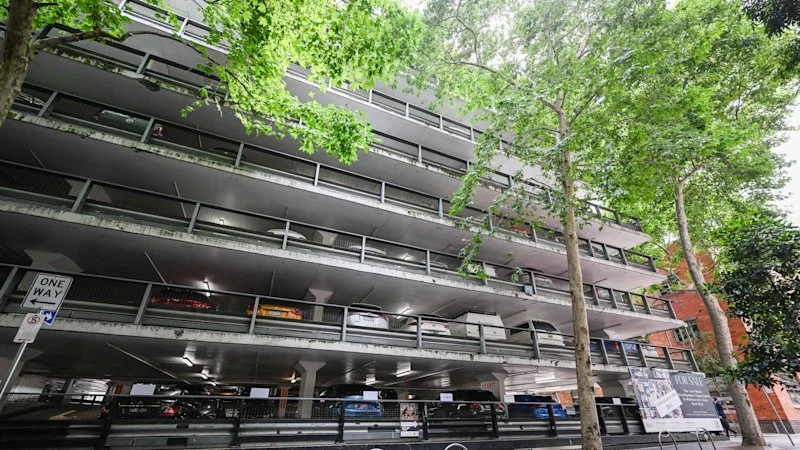
Australia could be heading toward a costly buildout of unwanted apartment parking, with a new report warning that rules requiring too many car spaces are helping to drive up housing costs while leaving basements half empty. The Grattan Institute says the country risks squandering $5.2bn by building 86,000 unwanted car parking spaces over the next five years.
The report says about 40% of parking spaces under apartments in Australia sit empty now, even as many new developments are still required to provide more. In Sydney, a new one-bedroom apartment must come with an average of 0.6 car spaces, despite about 40% of Australian households in a studio or one-bedroom apartment not having a car.
Grattan recommends scrapping rules that force developers to provide a minimum number of car parking spaces per bedroom in new builds. Dominic Behrens said the system has gone too far. “We’ve required too many parking spaces for a long time, and as a result, we’ve got a lot more than we want, need, or use, particularly under apartment buildings,” he said.
The cost is not abstract. Grattan estimated that parking rules add $70,000 to the cost of building a typical two-bedroom apartment in Sydney, $62,000 in Melbourne, $113,000 in Brisbane, $137,000 in Perth and $95,000 in Adelaide. The report says those added costs make it harder for developers to turn a profit on new housing, which can slow construction rather than speed it up.
The group argues the pain would not be spread evenly. Behrens said that if the rules were removed and more housing was built, “it’s rents at the lower end of the spectrum that would go down the most, and so really the biggest burden of these rules falls on the people who have the least capacity to pay.”
That argument cuts against a long-standing habit in Australian planning. Parking minimums were first imposed in the 1950s, and academics have criticised them for decades, yet they remain common nationwide and are usually built into local council planning rules. Some councils have already started reducing them, especially in suburbs with strong public transport, but the Grattan report says the wider system still pushes too much parking onto projects that do not need it.
David Mepham said the politics are a major obstacle. “Emotionally we’ve got this very deep connection to driving and what we can see as being a right to park,” he said. “It makes it very difficult for politicians to make rational decisions about parking, if once you start talking about reducing parking the next thing you know everyone’s on talkback radio having a meltdown about it.” He added that residents and traders quickly mobilise whenever parking is put on the table: “[Residents will] get on the phone to the councillor, and traders will give their councillor a rev. Everyone wants more parking, but no one wants to pay for it.”
The report’s answer is to move the burden away from apartment blocks and onto better-managed streets, using parking permit schemes, time limits and user charges in high-demand areas. Its conclusion is blunt: if Australia wants cheaper apartments, it will have to stop forcing builders to make room for cars that may never arrive.
