


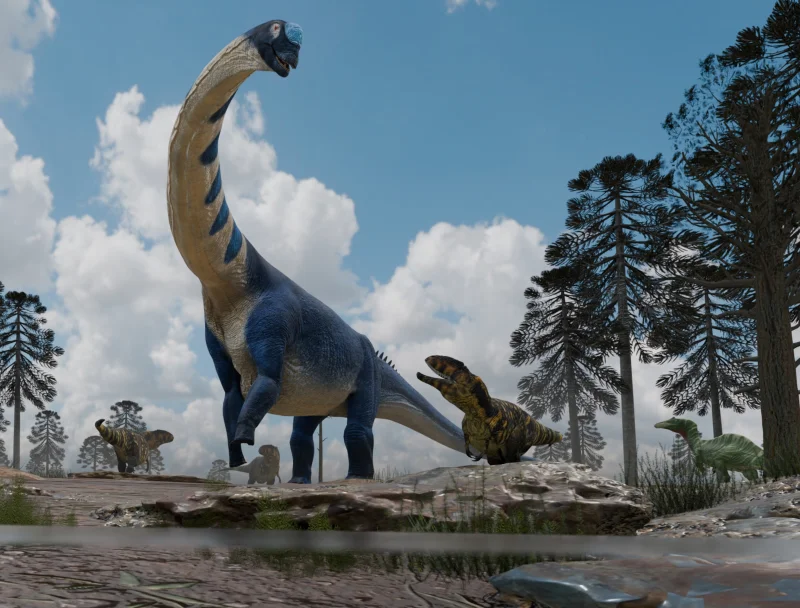
Scientists have identified a massive new dinosaur species in Thailand, a long-necked plant eater that may be the largest dinosaur ever found in Southeast Asia. The species, named Nagatitan chaiyaphumensis, lived more than 100 million years ago and adds a major new piece to the region’s fossil record, showing that truly giant sauropods roamed what is now northeastern Thailand during the Early Cretaceous period.
Thailand Discovery Identifies A New Prehistoric Giant
The newly named dinosaur was found in Chaiyaphum province, in rocks belonging to the Khok Kruat Formation. Researchers estimate that Nagatitan chaiyaphumensis reached roughly 27 meters, or nearly 90 feet, in length and weighed about 25 to 30 metric tons.
That size places it among the most imposing dinosaurs known from the region. While it was not as heavy as the largest South American titanosaurs, it was enormous by Southeast Asian standards and substantially expands what scientists know about dinosaur body size in the area.
The name combines “Naga,” a serpent-like figure important in Southeast Asian mythology, with “titan,” a reference to the dinosaur’s great size. The species name points to Chaiyaphum, the province where the fossils were recovered.
Fossils Began With Strange Rocks Near A Pond
The discovery began about a decade ago when unusual rocks were noticed near a pond in northeastern Thailand. Those rocks turned out to be fossilized bones from a giant sauropod, the group of dinosaurs known for long necks, long tails and four-legged bodies.
Excavation and study took years. The remains include parts of the spine, ribs, pelvis and limb bones, enough for researchers to determine that the animal had features separating it from other known sauropods. One of the most striking fossils is a large upper arm bone, underscoring the animal’s immense scale.
The skull and teeth have not been found, so some details of its appearance and feeding behavior remain incomplete. Even so, the preserved skeleton indicates a high-volume plant eater that likely browsed vegetation such as conifers, ferns and other plants common in its ancient environment.
Why Nagatitan Matters For Dinosaur Science
The discovery is important because Southeast Asia’s dinosaur record is still less complete than those of North America, China, Europe or South America. Each new species helps scientists reconstruct how dinosaurs spread, evolved and adapted across ancient landmasses.
Nagatitan belonged to a branch of sauropods with lightweight internal bone structures, including air-filled spaces that helped support massive bodies. Those adaptations allowed long-necked dinosaurs to grow to extraordinary size without their skeletons becoming impossibly heavy.

The new species also suggests that giant sauropods remained successful in the region later than previously understood. Researchers have described it as a possible “last titan” of Thailand because it comes from relatively young dinosaur-bearing rocks in the country. Later geological changes turned parts of the region into shallow seas, reducing the kind of terrestrial habitat where these giants lived.
Ancient Thailand Was A Warm, Dynamic Landscape
When Nagatitan chaiyaphumensis lived, the landscape of what is now Thailand was very different from the modern country. The region likely had warm conditions, river systems, floodplains, forests and more open habitats where large herbivores could feed.
The ecosystem would not have been empty. Other dinosaurs, crocodile-like reptiles, fish, turtles and flying reptiles lived in the same broader environment. Large carnivorous dinosaurs also inhabited the region, though an adult Nagatitan would have been difficult prey because of its size.
Its bulk may have been one of its strongest defenses. A 30-ton herbivore would have been vulnerable as a juvenile, but a full-grown adult could deter most predators simply by being too large and dangerous to attack easily.
Thailand’s Fossil Record Gains Global Attention
Thailand has produced a growing list of dinosaur finds, especially from the northeast, where fossil-bearing rocks have made the country one of Southeast Asia’s most important paleontology centers. The identification of Nagatitan adds to that record and gives Thai researchers a new flagship discovery.
The find also highlights the role of local observers and long-term fieldwork. Major fossil discoveries often begin with someone noticing something unusual in the ground, but turning those fragments into a scientifically named species requires careful excavation, comparison, dating and anatomical study.
For Thailand, the discovery strengthens its place in global dinosaur research. It also helps correct the impression that giant sauropods were primarily a story of the Americas, Africa or East Asia. Southeast Asia, too, supported huge dinosaurs with complex evolutionary histories.
More Answers May Come From The Same Rocks
The new dinosaur species raises fresh questions about what else remains buried in the Khok Kruat Formation. More complete fossils could clarify the animal’s neck length, skull shape, growth pattern and relationship to other sauropods across Asia.
For now, the discovery gives scientists a clearer view of a lost world in which giant plant eaters moved through ancient Thai landscapes more than 100 million years ago. Nagatitan chaiyaphumensis is not just a large dinosaur with a dramatic name. It is evidence that Southeast Asia’s prehistoric past was bigger, richer and more globally important than the fossil record had previously shown.
