


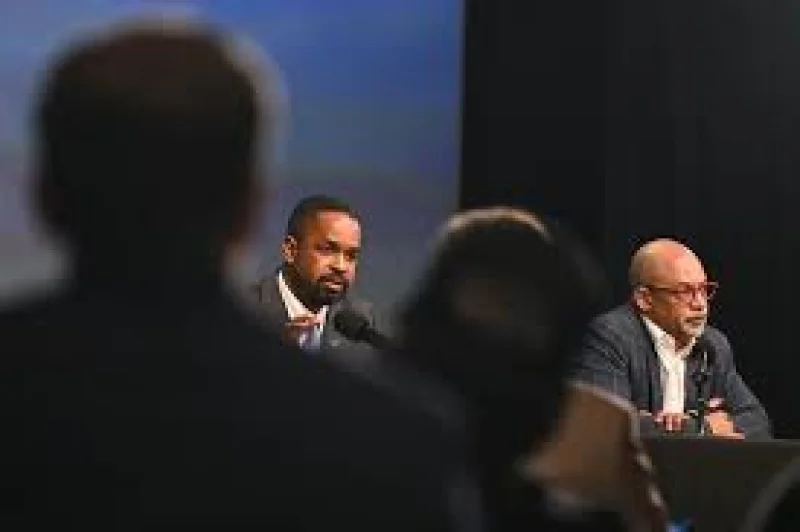
Anonymous texts attacking Philadelphia voters over state Rep. Chris Rabb landed days before Tuesday’s primary election, accusing the 3rd Congressional District candidate of spreading conspiracy theories and holding extremist views. One message called Rabb a candidate who had embraced controversy and online extremism over serious leadership.
The attacks have intensified an already crowded and costly race in one of the bluest districts in the U.S., where no clear front-runner had emerged with Election Day just hours away. Rabb is one of three leading candidates, alongside moderate state Sen. Sharif Street, an influential party figure who won the official endorsement, and physician Ala Stanford, who has drawn backing from a pro-science super PAC with deep-pocketed support.
Anthony Campisi, a Street campaign spokesperson, confirmed Monday that the texts came from Philadelphia’s Democratic City Committee, which is coordinating with Street’s campaign after the endorsement. Bob Brady, who leads the city committee, denied any involvement. “We did not pay for any of them,” he said, adding, “This is the first time I am seeing these.”
The messages pushed beyond generic attack-line politics. One referenced a since-deleted social media post in which Rabb claimed the antisemitic attack at Bondi Beach in Australia was a false flag event orchestrated by Zionists. Another pointed to his support for leftist political commentator Hasan Piker. Other texts used an AI-generated image of Rabb seeming to admit he had accomplished little in Harrisburg. Federal Election Commission rules require campaign communications sent to voters, including texts, to identify who paid for them and say whether they were authorized by the candidate or campaign.
Rabb said the attribution rules may keep voters in the dark until after the vote, if ever. “There’s a reason for these rules — and unfortunately we’re not likely to know whom we can attribute these negative messages until after [the election], if at all,” he said Monday.
The timing matters because the race has turned into a high-stakes test of a deeply Democratic district where outside interest groups have already spent millions on television ads and other campaign material for all three candidates. Rabb, a progressive who has long clashed with the local Democratic Party, is running against Street, who secured the party’s official nod, and Stanford, whose campaign has been buoyed by super PAC support. With the primary set for Tuesday, the texts have become part of the final argument over who can unite a fractured field and what kind of politics the district wants to send to Washington.
What remains unresolved is not whether the messages were real, but whether voters will ever be told with certainty who paid for them before they cast ballots.
