


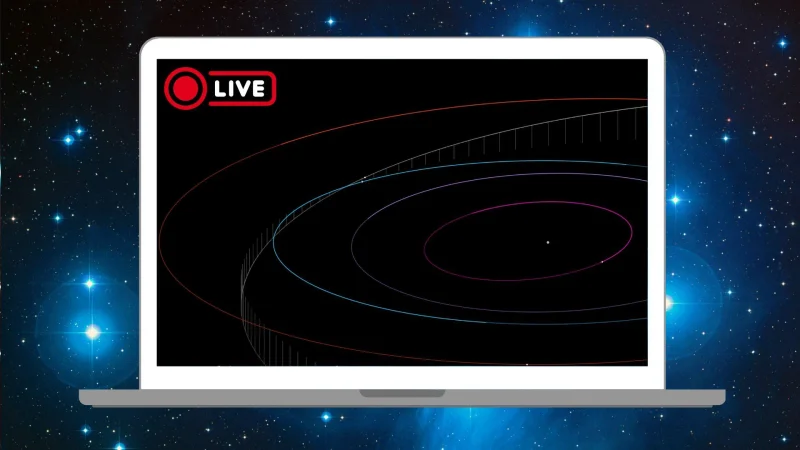
A newly discovered near-Earth asteroid, 2026 JH2, is set to make its closest approach to Earth at 5:23 p.m. ET on May 18, passing within 56,628 miles while racing by at 19,417 mph relative to our planet.
The object, found by the Mount Lemmon Survey in Arizona on May 10, is small but not tiny. Follow-up observations backed by the European Space Agency estimate it measures between 52 and 114 feet, or 16 to 35 meters, based on how bright it appears. That makes it large enough to draw attention from skywatchers, but not large enough to change the basic verdict from researchers: this pass is not expected to pose a threat to the moon or Earth.
For people who want to watch the flyby unfold, the Virtual Telescope Project plans a free YouTube livestream beginning at 3:45 p.m. EDT, or 19:45 GMT, on May 18, weather permitting. The group says it expects to show the asteroid from robotic telescopes in Italy, also weather permitting. Gianluca Masi, the project’s founder, said the object will be moving pretty fast against the stars during observation. He said it will be almost at its minimum distance, peaking in brightness around magnitude 11.5, before it sets below the horizon. In his words, the team will see it as a sharp dot of light moving against the starry background, with the stars leaving long streaks as the telescopes track the asteroid.
That near-miss is the main reason 2026 JH2 matters today. The asteroid was only identified eight days before its closest pass, a short lead time that underscores how some near-Earth objects are spotted late even when they come close enough to be tracked in real time. It also gives observers a brief window to study how such a body looks and moves at close range.
What happens after May 18 is less dramatic, but just as important for the long view. ESA says 2026 JH2 will then begin a 3.8-year round trip that carries it out close to Jupiter’s orbit before looping back toward the sun. Its next close pass of Earth is expected in 2060, when it will come within 17 times the Earth-moon distance. For now, Masi said, the asteroid poses no threat during this approach. The skywatching moment is short. The orbital story lasts much longer.
