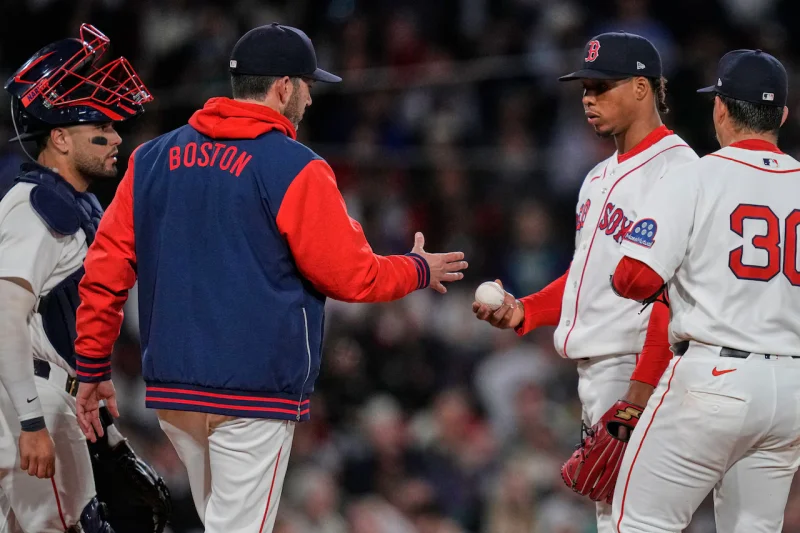
The Atlanta Braves closed their weekend series against the Boston Red Sox with an 8-1 win Sunday at Truist Park, taking two of three games and reinforcing their strong home form. The series opened with Spencer Strider steadying Atlanta in a tight extra-inning victory, included a Boston comeback in the middle game, and ended with the Braves’ lineup overwhelming Brayan Bello early.
Braves Turn Rubber Match Into A Statement
Atlanta wasted little time taking control of Sunday’s finale. Austin Riley hit a three-run homer in the first inning, setting the tone against Bello and giving the Braves immediate command of the game. Mike Yastrzemski later added a leadoff homer, while Drake Baldwin drove in multiple runs as Atlanta scored in four of the first five innings.
Bello never found much rhythm. The Red Sox right-hander worked through a long first inning and allowed seven runs across five innings, giving Boston too large a deficit to chase. The Braves’ early pressure also removed much of the late-game tension that had defined the first two matchups of the series.
Grant Holmes handled the lead efficiently, throwing six scoreless innings and keeping Boston from building a meaningful rally. Atlanta’s bullpen finished the game with little trouble, allowing only a ninth-inning run.
Spencer Strider Opened The Series With A Strong Return
The weekend began Friday with a far tighter game, one that Atlanta won 3-2 in 10 innings. Strider made his third start of the season and gave the Braves a controlled outing, allowing one run over 5 1/3 innings while striking out four.
His outing mattered beyond the box score. Strider’s return to effective work gives Atlanta another high-end rotation piece at a time when the Braves are trying to separate themselves as a National League contender. He did not overpower Boston for a double-digit strikeout night, but he limited damage, worked around traffic and left with Atlanta ahead.
The Braves eventually won on Yastrzemski’s walk-off double in the 10th. The game also produced one of the weekend’s lighter viral moments: the matchup between Strider and Red Sox utility man Mickey Gasper, which drew online attention because of the two players’ distinctive mustaches as much as the baseball itself.
Mickey Gasper Finds A Small Opening For Boston
Gasper’s weekend became a point of curiosity for fans searching the series because of his plate appearances against Strider and his role in Boston’s lineup. On Friday, he singled in the fourth and later drove in Boston’s first run with an RBI single in the sixth after Strider had exited.
The Red Sox used Gasper as the designated hitter during the series, reflecting Boston’s continued search for production and flexibility across a lineup that has struggled to generate consistent offense. His contributions were not enough to swing the series, but they gave Boston one of its few productive moments in the opener.
The larger problem for the Red Sox was that too many scoring chances came and went. Boston’s running game was also cut down repeatedly Friday, with Atlanta catcher Sandy León helping erase threats on the bases. In a one-run extra-inning loss, those missed opportunities carried real weight.
Boston’s Best Moment Came In Game Two
The Red Sox did answer Saturday with a 3-2 comeback win, preventing Atlanta from sweeping the series. Willson Contreras delivered the decisive blow with a two-run homer in the eighth inning after Wilyer Abreu doubled with two outs.
Peyton Tolle gave Boston the pitching performance it needed, working eight innings and allowing only two runs. Aroldis Chapman closed the ninth despite traffic on the bases, preserving a win that briefly shifted momentum back toward the Red Sox.
That victory showed Boston’s clearest path: strong starting pitching, enough left-handed damage from the lineup and clean late-inning execution. The issue was sustainability. By Sunday, Atlanta’s offense had reset the terms of the matchup and forced Boston into another uphill game.
What The Series Says About Both Teams
For Atlanta, the series was another sign of balance. The Braves won one game with pitching and late execution, lost a tight bullpen-and-power contest, then responded with a comfortable offensive performance. That range is what contending teams need over a long season.
Riley’s homer, Yastrzemski’s extra-base production and Baldwin’s continued run creation gave Atlanta length beyond its most obvious stars. The pitching staff also kept Boston from building big innings, a theme that has helped the Braves maintain control at home.
For Boston, the weekend was more uneven. The Red Sox had enough pitching to steal the middle game and enough individual moments from Gasper, Abreu, Contreras and Jarren Duran to stay competitive at times. But the finale exposed the gap between a team trying to piece together consistent offense and a Braves club that can punish mistakes quickly.
Red Sox Leave Atlanta With More Questions
The Red Sox move on from the Braves game with concerns about run production, starting depth and the health of catcher Carlos Narváez, who exited Sunday after finger pain following a rain delay. Boston’s path forward depends on getting more from the middle of the order and avoiding the early deficits that made Sunday’s game feel settled almost immediately.
Atlanta leaves the series with stronger confirmation. Strider looked steady, the lineup delivered in the finale, and the Braves again showed why Truist Park has become such a difficult stop for visiting teams. The weekend did not answer every long-term question for either club, but it left a clear impression: Atlanta handled the biggest moments of the series better, while Boston’s flashes of resistance were not enough to change the outcome.