


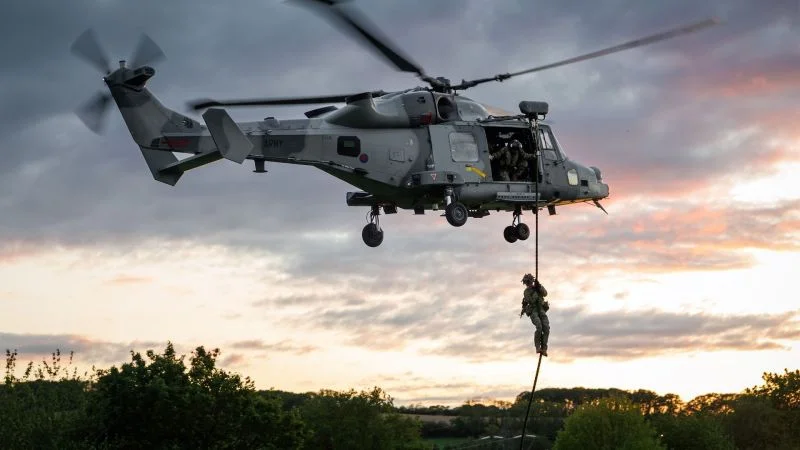
Royal Marines from 42 Commando rehearsed vehicle seizure drills and helicopter raids on Salisbury Plain as they prepared for upcoming operations. The exercise brought in two Special Operations Maritime Task Units and saw commandos train to stop vehicles, detain occupants and then strike from the air.
The drills began with the initial seizure of a white van, then moved into fast-moving raids backed by Wildcat helicopters from 847 Naval Air Squadron. While the aircraft provided overwatch, the commandos detained the people inside and searched the vehicles before forming a helicopter assault force and fast-roping onto multiple landing sites, including high-rise buildings and key transport routes.
The training matters now because the UK Commando Force is preparing to deploy to the United States, where it will work alongside the U.S. Navy Special Operations Force. The maritime teams attached to the exercise are specialist units built for maritime counter-terrorism, vessel boarding and covert coastal raids, and each one can provide one force protection team and two boarding teams. They can also be reinforced with scout snipers, uncrewed systems, dive teams or explosive ordnance disposal support, depending on the mission.
That flexibility is the point of the drill. The officer in command of Special Operations Maritime Task Unit 1 said the ability to insert forces by air, land or sea allows commandos to deploy quickly into complex, contested and dynamic environments at short notice. He said continued development of allied and regional partnerships strengthens warfighting capability and deepens understanding of a strategically vital operating area, and added that Lima Company routinely delivers military assistance to priority partners while standing ready to support freedom of navigation and maritime security operations.
The exercise also underlines a friction that runs through modern commando work: these units are preparing for operations that can move from coastal boardings to inland seizures in a matter of moments, yet the environment they are training for is changing as fast as their kit and tactics. Salisbury Plain offered the practice ground; the next test will come when the force is alongside American counterparts. For the Royal Marines, the question is no longer whether they can switch from sea to land to air in one sequence. It is whether that speed will hold when the deployment begins in the United States.
