


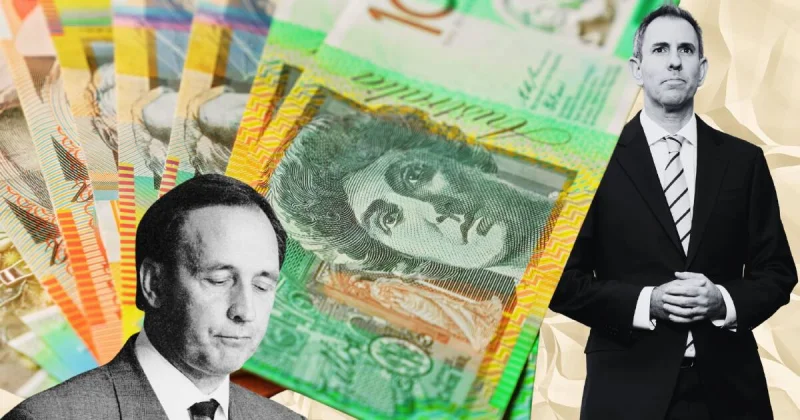
Jim Chalmers used his fifth budget on Tuesday night to offer a $250 Working Australia Tax Offset while leaning on the biggest savings measure in the package: $37.8 billion in NDIS savings over the forward estimates and $184.9 billion over the next 10 years.
The budget lands in a country still living with the aftermath of the pandemic spending surge, and it does not reverse it. Federal and state outlays remain on a new record-high plateau above 26 per cent of GDP, with overall government spending approaching 40 per cent of GDP. That is the backdrop to the latest round of Australia budget 2026 tax changes, which are being sold as relief for households even as the state stays larger than it was before the crisis.
Mark Butler signalled how far Labor had already moved before the budget was even released. Three weeks earlier, he called Labor's $52 billion National Disability Insurance Scheme broken and said the roll was on track to grow from 760,000 people to well over 900,000 by 2030. He also said Labor would slash the demand-driven scheme to 600,000 people by 2030. In other words, the NDIS is not just a line item in this budget. It is the central place where the government says it can find savings without blowing out the deficit further.

The politics of that choice are sharper because the current debate is not really about one program. It is about whether Australia can keep financing a bigger care state while the economy grows more slowly. The Reserve Bank says the expanding low-productivity care economy has lowered the country's annual growth potential to just 2 per cent. Last week, Governor Michele Bullock warned Australians are poorer after the Middle East oil price shock. Put together, those warnings point in the same direction: a budget that gives with one hand while trying to arrest a long-term squeeze on national income with the other.
This is where the old history returns. On May 14, 1986, Paul Keating warned Australia would become a third-rate economy and a banana republic unless it adjusted to lower national income. Keating and Peter Walsh later cut federal spending from 27 per cent to 23 per cent of GDP and delivered a budget surplus equal to 1.5 per cent of GDP. Chalmers is not trying to recreate that era, but the comparison hangs over his budget all the same: a government can promise relief, protect popular programs and still be forced back to the arithmetic of lower growth.
The tension in this budget is that the savings story and the spending story point in opposite directions. Chalmers has found the NDIS as the main source of restraint, yet the budget still locks in a post-pandemic level of public spending that sits far above the old norm. That leaves a simple question now answered by the numbers in the budget itself: Australia is not cutting its way back to a smaller state, even as it warns that the bill for keeping the current one in place is rising.
