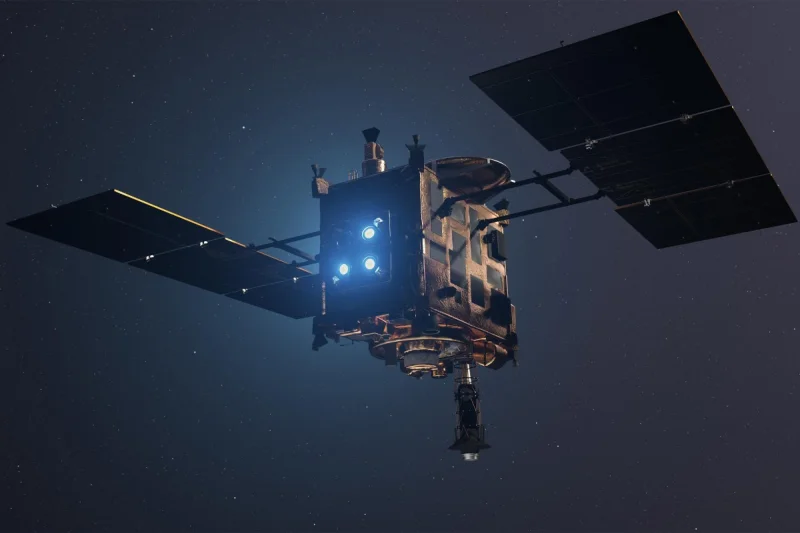
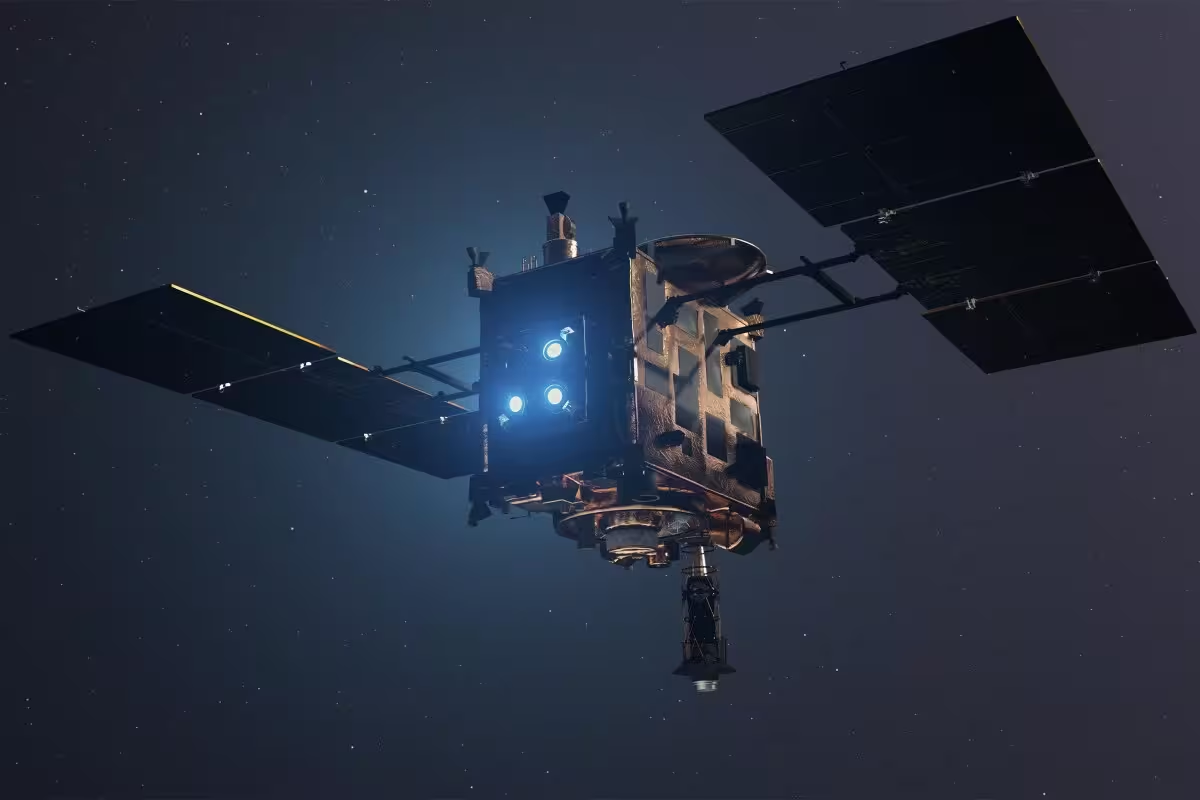
Japan’s Hayabusa2 mission is headed toward a tiny object long described as an asteroid, but a new paper argues it may be something stranger: the dead shell of a Soviet Mars probe. Avi Loeb and colleagues say 1998 KY26, the target Hayabusa2 is due to reach in July 2031, could be the lost Phobos 1 spacecraft rather than a natural rock.
That matters now because Hayabusa2 is already on the way after its earlier success at Ryugu, where it rendezvoused in June 2018 and returned a sampled cache of rocks to Earth. If 1998 KY26 turns out to be technological debris, the mission would not just be visiting another small asteroid. It would be approaching a piece of human hardware from the Cold War era, and the label attached to the object would change the meaning of whatever Hayabusa2 sees.
Loeb identified the object in a blog post as a possible relic of Phobos 1, a mission launched in July 1988 that failed two months later and never sent back a signal in August 1988. The probe’s loss was later traced to a typo, a missing hyphen in a command that shut down crucial systems. In the new paper, which has not yet been peer reviewed, Loeb and his co-authors say the probe’s thruster firings may have left it in an orbit similar to 1998 KY26, with the two paths converging in a way they describe as statistically compatible.
The claim is not built on orbit alone. The researchers say the object and the defunct spacecraft are about the same size and share a highly elongated shape, the same sort of odd profile that has helped keep 1998 KY26 in the spotlight. Scientists have also suggested it could be a dark comet, a class of object that has gained attention since 2017 after 1I/'Oumuamua was used as a basis for the idea. Loeb, who has spent years pondering 'Oumuamua and its unusual behavior, is trying to push that argument one step further.
He says astronomers should widen the training data they use when they classify strange bodies in space. In his words, they should extend the data set to include not just rocks and icebergs but also the space objects launched by humans over the past 69 years. He also asked whether the mainstream comet community would be willing to reconsider 1I/'Oumuamua if 1998 KY26 ends up looking technological beyond any reasonable doubt.
There is still a large gap between the paper’s argument and proof. 1998 KY26 is described as a tiny, rapidly spinning asteroid, and Hayabusa2’s visit could be difficult because of that speed. The mission is expected to arrive in July 2031, and the spacecraft’s observations should be the first real test of whether the target is a natural body, a dark comet or something built by human hands. For Loeb, that is the point: the answer may be sitting in the asteroid belt of assumptions until Hayabusa2 reaches it.