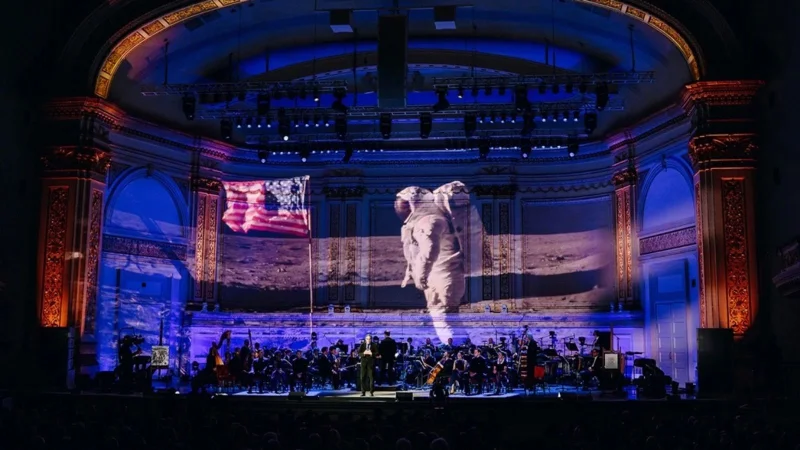
PBS will premiere We Chose to Go to the Moon on November 10, bringing a two-hour live-recorded performance from Carnegie Hall to its website, app and broadcast audience. The stage piece blends documentary material, music and multimedia into a theatrical retelling of the early Space Age and Apollo era.
The timing gives the show a fresh audience just as the 60th anniversaries of the Apollo program begin to come into view. For viewers searching the title now, that is the draw: a new package of familiar history, delivered in a format PBS describes as a living documentary and immersive theatrical experience.
John Monsky serves as narrator on stage, while a small cast moves between spoken word and singing with an orchestra behind them and large images and video projected over the performance. The show also leans on era songs such as “Space Oddity” and “Age f Aquarius,” a choice that gives the production a concert feel even as it works through the record of Apollo.

The centerpiece of the story remains Neil Armstrong, who is the closest thing to a central historical figure in the performance. The production includes a small swatch of material cut off in making the flag that would go to the Moon on Apollo 11, along with a felt-tip pen made in Brooklyn that Buzz Aldrin used to fix a broken ignition switch in the lunar module on Apollo 11. Those objects give the show texture, even if the larger arc stays close to the familiar ground of Moon-landing history.
That is where the promise of something new runs into the limits of the material. The production is framed as an immersive retelling, yet the history itself is well worn, and the review finds it unlikely to teach viewers much they do not already know. What it does offer is a polished, novel way to revisit the story, one that turns archive, music and performance into a single televised event.
Ron Howard opens the show by saying what viewers are about to see is unlike any telling of mankind’s journey to the Moon that he has experienced. Near the end, Neil Armstrong’s son Mark and granddaughter Kali appear, and Kali sings a song Mark wrote about Armstrong’s love of flying gliders. The performance then moves into a coda that fast-forwards to the present day and Artemis 2, closing the loop between the Apollo era and the next chapter NASA hopes to write.