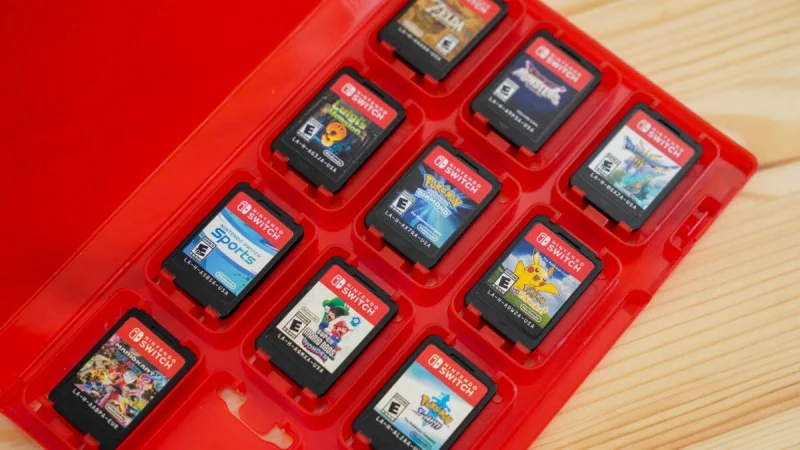
Macronix is quitting the Switch business, and that means the company that has supplied the ROM chips inside Switch 1 and Switch 2 game cards is winding down a role that has quietly sat behind Nintendo’s physical releases. David Gibson said late on Tuesday that there will be no new ROM products, and that Q3 is the last quarter Macronix will report ROM sales separately.
The timing matters because Nintendo’s physical cards are already under pressure from a market that keeps tilting digital. Nintendo said in its last earnings report in August that just under 60% of all sales on its platforms were digital, while it also began selling physical game cards at a $10 premium over digital titles this year. That leaves fewer reasons to keep investing in a supply chain built around plastic cards, even as the cards themselves remain important for big releases and collectors.
Gibson’s numbers show why Macronix can step away without upending its broader business. He said the ROM storage line made up less than 5% of Macronix’s sales last quarter, down from 23% a year ago, while the company’s other work is in eMMC and NAND storage. In other words, the switch away from ROM is not a retreat from memory entirely; it is a retreat from a low-revenue corner of a much wider chip business.

Even so, the loss of Macronix still matters to Nintendo because the company was the main supplier of memory for physical cartridges, even if it was not the only one. Nintendo’s latest game cards now go up to 64GB, and that makes the supply chain more sensitive for larger-card releases and for third-party publishers that have been pushed toward game-key cards because full physical cards are expensive to produce. Titles such as The Elder Scrolls V: Oblivion Remastered and Indiana Jones and the Great Circle sold out quickly after launch as wholly on-card physical copies, a reminder that demand for real cartridges has not disappeared.
The friction is simple: Nintendo still needs physical cards for some of its biggest games, but one of the few companies making the memory inside them is leaving the business. Macronix is not Nintendo’s sole provider, so the cards do not stop overnight, but the pool gets thinner just as digital sales keep growing and the economics of physical software get worse. Mat Piscatella said in June that there is likely less than a decade left for physical software, and he said physical sales saw only the slightest bump this year, mostly because of Switch 2.
What comes next is less about a sudden shutdown than a gradual squeeze. Nintendo’s next earnings call this week may offer a better read on how it plans to keep physical cards viable, but no replacement supplier has been identified. If that gap stays open, Nintendo will have one more reason to lean harder into digital sales and one less reason to treat cartridge production as a core part of its future.