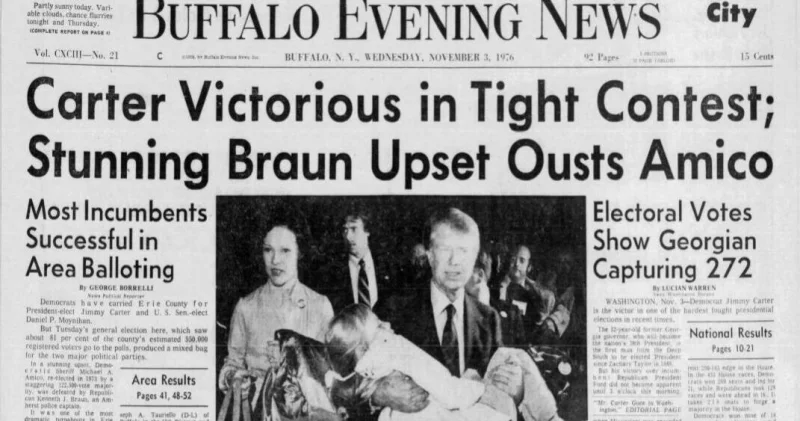
On Nov. 2, 1976, James Earl Carter Jr. won the White House by a narrow margin, unseating Gerald Ford and becoming the 39th president of the United States. Fifty years later, that race still stands as the moment Carter moved from a little-known Georgia politician to the center of American power.
Carter, born in Plains in 1924, had already traveled a long road by then. He went from Naval submariner to state senator and then to Georgia governor in 1970, before completing his political ascent as a one-term governor in the White House. He also broke tradition by walking down Pennsylvania Avenue during his inaugural parade, a small gesture that matched the outsider image voters had just rewarded.
The victory mattered because it came in a country still looking for trust after the political upheaval of the era, and because Carter did not stay a footnote once he arrived in office. His administration helped produce the Camp David Accords between Egypt and Israel, complete the Panama Canal treaties, normalize diplomatic relations with China, create the Department of Energy and the Department of Education, and enact the Alaska National Interest Lands Conservation Act.

But the arc of Carter’s life also showed how quickly a political ascent can bend. He lost his 1980 reelection bid to Ronald Reagan, a reminder that the narrowness of his 1976 win was matched by the limits of his presidency at the ballot box. The contrast did not end his public life; it redirected it.
In 1982, Carter and Rosalynn founded the Atlanta-based Carter Center, which works to advance global human rights, eradicate neglected diseases, and monitor international elections. He later won the Nobel Peace Prize in 2002 and, with Rosalynn, served as the public face of Habitat for Humanity for 35 years. He also taught Sunday school at Maranatha Baptist Church in Plains for nearly four decades, a local post that kept him tied to the town where he was born.
Carter became the longest-lived president in American history, and on Dec. 29, 2024, he died at his home in Plains at age 100. The clear reading of his story is that the 1976 election was not just the start of a presidency; it was the opening chapter of a public life that outlasted the office that first made him famous.