
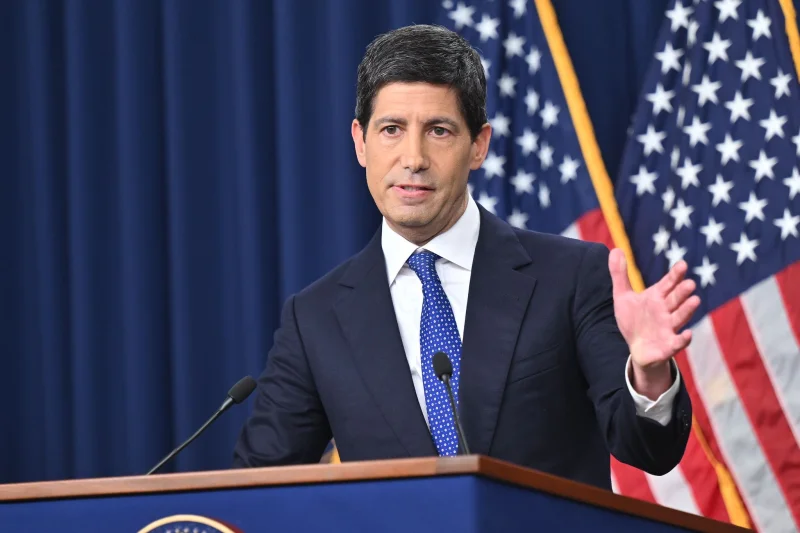
Kevin Warsh said after the Oct. 28 FOMC meeting that “interest rates get in the cracks,” a line that landed directly on Wall Street’s newest market favorite: AI. He and his Federal Open Market Committee colleagues had just voted to hold rates steady, but his post-meeting comment pointed to the part of the market that can still feel tighter money even when the Fed pauses.
The line matters because AI has been one of the main engines behind the stock market’s recent gains, and the companies driving that boom are not all funding it the same way. Some are using stock issuances and cash on hand, but the article also says AI hardware demand is being financed in part with debt. That is where Warsh’s comment bites. When borrowing costs rise, debt-funded build-outs can become more expensive to carry, and that can weigh on expansion plans as well as near-term growth projections.
The timing is what gives the remark force. The Fed’s annualized inflation had stayed above its long-term 2% target for 67 consecutive months at the time of the Oct. 28 decision, and traders are already looking past the hold. The CME Group FedWatch Tool puts a 72% chance on a 25-basis-point rate hike in December, with nearly 50% odds of 75 basis points in cumulative hikes by Sept. 15, 2027. In other words, Warsh’s warning was not about a distant risk. It was about a market that is already pricing in more tightening.
That is why the pressure does not stop at AI stocks. The article also points to total U.S. national debt of $40.1 trillion, a level that magnifies the cost of every rate move. A 1 percentage point increase in the average cost of servicing that debt now translates to about $401 billion a year in interest expense, compared with about $89 billion in 2007. Higher rates hit borrowers first, but they eventually work through the whole system, including the businesses trying to build the next wave of AI infrastructure.
Warsh’s blunt six-word answer did not change the FOMC’s decision on Oct. 28. It changed the way investors have to read it. AI may still be driving the rally, but if more of that growth depends on borrowed money, the next rate move could matter more than the latest earnings story.